Monday, June 24, 2013

N is for NIGHTINGALE


I am not sure there is anything special about the nightingale, apart from its magnificent song, but when trying to think of a bird beginning with the letter N, I remembered when I was a child there was a very popular song "A Nightingale Sang in Berkley Square.  It was during the war years (WW2) and Vera Lynn sang the song beautifully.  I feel that love songs are so important to everyone in war time.
Others have done justice to the song as well, including Frank Sinatra.

The Common Nightingale or simply Nightingale (Luscinia megarhynchos) also known as Rufous Nightingale, is a small passerine bird that was formerly classed as a member of the thrush family Turdidae, but is now more generally considered to be an Old World Flycatcher, Muscicapidae.  It belongs to a group of more terrestrial species, often called chats.


The Common Nightingale is slightly larger than the European Robin, at 15-16.5 cm (5.9-6.5 in) in length.  It is plain brown above except for the reddish tail.  It is buff to white below.  Sexes are similar.  The eastern subspecies have paler upperparts and a stronger face pattern.  The song of the Nightingale has been described as one of the most beautiful sounds in nature, inspiring songs, fairy tales, opera, books and a great deal of poetry.

Nightingales are named so as they frequently sing at night as well as during the day.  The name has been used for well over 1,000 years, being highly recognisable even in its Anglo-Saxon form - "nightingale".  It means "night songstress".  Early writers assumed the female sang when it is in fact the male.  The song is loud, with an impressive range of whistles, trills and gurgles.  Its song is particularly noticeable at night because few other birds are singing.  This is why its name includes 'night' in several languages.  Only unpaired males sing regularly at night, and nocturnal song is likely to serve to attract a mate.  Singing at dawn, during the hour before sunrise, is assumed to be important in defending the bird's territory.  Nightingales sing even more loudly in urban or near-urban developments, in order to overcome the background noise.  The most characteristic feature of the song is a loud whistling crescendo, absent from the song of the Thrush Nightingale.  It has a frog-like alarm call.


You can listen to the "Song of the Nightingale" by popping those words into Google.  I thought it was rather nice and yet I felt our canary had a better song but perhaps I am prejudiced.  I did ask Phil if he remembered hearing nightingales singing when he lived in England.  He said he had heard them but it is now over 53 years and he remembers the song of our canary much better so I didn't get very far there.  The nightingale has been associated with romance over the centuries so it certainly must have something that inspires poets and the like.  I thought the following quite interesting.  I've not heard this music but would dearly love to do so.  Once again it seems the nightingale has been an inspiration.


Sunday, June 23, 2013

THERE IS A SUPERMOON ABOVE AUSTRALIA TONIGHT

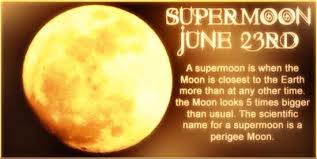
A supermoon will be visible above Australia tonight, which will create an impressive view in the early evening sky and bring with it a king tide.  The moon will appear bigger and bolder than usual as it passes closer to the Earth just in time for a full moon.


I have kept occasionally peering up at the eastern sky but it has been very cloudy so just a warm glow showing through.  I just went out and checked and the skies have cleared but of course the moon is up higher in the sky now so disappointing we didn't see it as it rose as it would have been so much larger.  I didn't take this photo but it would be pretty much as we saw the moon just a few moments ago.  Still quite a magnificent sight.

I hope others in Australia were able to see this supermoon as it rose this evening in your skies.


23rd/24th JUNE - MIDSUMMER'S DAY (In the UK)

This festival is primarily a Celtic fire festival, representing the middle of summer, and the shortening of the days on their gradual march to winter.   Midsummer is traditionally celebrated on either the 23rd or 24th June, although the longest day actually falls on the 21st of June.  The importance of the day to our ancestors can be traced back many thousands of years, and many stone circles and other ancient monuments are aligned to the sunrise on Midsummer's Day.  Probably the most famous alignment is that at Stonehenge, where the sun rises over the heel stone, framed by the giant trilithons on Midsummer morning.

In antiquity midsummer fires were lit in high places all over the countryside, and in some ares of Scotland Midsummer fires were still being lit well into the 18th century.  This was especially true in rural areas, where the weight of reformation thinking had not been thoroughly assimilated.  It was a time when the domestic beasts of the land were blessed with fire, generally by walking them around a fire in a sun-wise direction.  It was also customary for people to jump high through the fires, folklore suggesting that the height reached by the most athletic jumper, would be the height of that year's harvest.


After Christianity became adopted in Britain, the festival became known as St John's Day (St John's Fire as depicted by Nikolai Astrup, 1912 .. see above) and was still celebrated as an important day in the church calendar; the birthday of St John the Baptist.  Traditionally St john's Eve (like the eve of many festivals) was seen as a time when the veil between this world and the next was thin, and when powerful forces were abroad.  Vigils were often held during the night and it was said that if you spent a night at a sacred site during Midsummer Eve, you would gain the powers of a bard, or on the down side you could also end up utterly mad, deaf, or be spirited away by the fairies.


Indeed, St Johns Eve was a time when fairies were thought to be abroad and at their most powerful (hence Shakespeare's Midsummer Night's Dream).

St John's Wort was also traditionally gathered on this day, thought to be imbued with the power of the sun.  Other special flowers (Vervain, trefoil, rue and roses) were also thought to be most potent at this time, and were traditionally placed under a pillow in the hope of important dreams. especially dreams about future lover.

The festival of Midsummer is still important to pagans today, including the modern day druids who (barring any trouble) celebrate the solstice at Stonehenge in Wiltshire.  For them the light of the sun on Midsummer's Day signifies the sacred Awen.  For witches the summer solstice forms one of the lesser sabbats, their main festivals being Beltane (1st May) and Samhain (1st November).  Some occultists still celebrate the ancient festivals around 11 days later than our calendar; this marks the 11 days which were lost when the Gregorian calendar replaced the Julian calendar in 1751.

The above information taken from "www.mysteriousbritain.cu.uk/

Saturday, June 22, 2013

M is for MALLEEFOWL

The Malleefowl (Leipoa ocellata) is a stocky ground-dwelling Australian bird about the size of a domestic chicken (to which it is distantly related).  They are notable for the large nesting mounds constructed by the males and lack of parental care after the chicks hatch.  It is the only living representative of the genus Leipoa, though the extinct Giant Malleefowl was a close relative.  It occupies semi-arid mallee scrub on the fringes of the relatively fertile areas of southern Australia, where it is now reduced to three separate populations; the Murray-Murrumbidgee Basin, west of Spencer Gulf along the fringes of the Simpson Desert, and the semi-arid fringe of Western Australia's fertilie south-west corner. 

Malleefowl are shy, wary, solitary birds that usually fly only to escape danger or reach a tree to roost in. Although very active, they are seldom seen as they freeze if disturbed, relying on their intricately patterned plumage to render them invisible, or else fade silently and rapidly into the undergrowth (flying away only if surprised or chased).  They have many tactics to run away from predators.  As you can see by the following picture their camouflage is excellent:


Malleefowl pairs occupy a territory but usually roost apart; their social behaviour is sufficient to allow regular mating during the season and little else.  In winter the male selects an area of ground, usually a small open space between the stunted trees of the mallee, and scrapes a depression about three metres across and just under a metre deep in the sandy soil by raking backwards with his feet.  In late winter and early spring, he begins to collect organic material to fill it with, scraping sticks, leaves and bark into the wind-rows for up to 50 metres around the hole, and building it into a nest-mound, which usually rises to about 0.6 metres above ground level.  The amount of litter in the mound varies; it may be entirely organic material, mostly sand, or anywhere in between.


After rain, he turns and mixes the material to encourage decay and, if conditions allow, digs an egg chamber in August (the last month of the southern winter).  The female sometimes assists with the excavation of the egg chamber, and the timing varies with temperature and rainfall.  The female usually lays between September and February, provided there has been enough rain to start organic decay of the litter.  The male continues to maintain the nest-mound, gradually adding more soil to the mix as the summer approaches (presumably to regulate the temperatures).


The malleefowl below is in Ongerup, Western Australia and, as you can see, the size of the mound is quite considerable.


Males usually build their first mound (or take over an existing one) in their fourth year, but tend not to achieve as impressive a structure as older birds.  They are thought to mate for life, and although the male stays nearby to defend the nest for nine months of the year, they can wander at other times, not always returning to the same territory afterwards.


The female lays a clutch of anywhere from two or three to over 30 large, thin-shelled eggs, mostly about 15; usually about a week apart,  Each egg weighs about 10% of the female's body weight and over a season it is common for her to lay 250% of her own weight.  Clutch size varies greatly between birds and with rainfall.  Incubation time depends on temperature and can be anywhere between about 50 and almost 100 days.

Hatchlings use their strong beaks to break out of the egg, then lie on their backs and scratch their way to the surface, struggling hard for five or ten minutes to gain 3 to 15 cm at a time, and then resting for an hour or so before starting again.  Reaching the surface takes between 2 and 15 hours.  Chicks pop out of the nesting material with little or no warning with eyes and beaks tightly closed, then immediately take a deep breath and open their eyes, before freezing motionless for as long as 20 minutes.

The chick then quickly emerges from out of the hole and rolls or staggers to the base of the mound, disappearing into the scrub within moments.  Within an hour it will be able to run reasonably well; it can flutter for a short distance and run very fast within two hours, and despite not having yet grown tail feathers, it can fly strongly within a day.  Chicks have no contact with adults or other chicks; they tend to hatch one at a time and birds of any age ignore one another except for mating or territorial disputes.


MALLEE (see above picture):  Is the growth habit of certain eucalypt species that grow with multiple stems springing from an underground lignotuber, usually to a height of no more than ten metres.  It is most common in plants of the genus Eucalyptus, many of which naturally grow in a mallee habitat, and some of which grow as single-stemmed trees initially but recover in mallee form if burnt to the ground by bushfires. It also occurs in the closely related general Corymbia and Angophora.  The word mallee may also be used as a noun in reference to species or individual plants with a mallee habit.  Mallees are the dominant vegetation throughgout semi-arid Australia with reliable winter rainfall.  Within this area, they form extensive woodlands and shrublands covering over 250,000 square kilometres.  Thus mallee woodlands and shrublands are considered one of Australia's major vegetation groups.

Apologies if this post is a wee bit long but I found so many fascinating things about our malleefowl and didn't want to leave out anything of importance.


Tuesday, June 18, 2013

L is for LYREBIRD

The Lyrebird has been around for millions of years, fossile having been found dated to 15 million years ago.  This wonderful Australian bird can be found in forest habitats in Victoria and New South Wales.  It was also brought to Tasmania in the 19th century.  There are two different species of lyrebirds: the Superb Lyrebird and Albert's Lyrebird.  The male Superb Lyrebird is the third largest songbird with a length of 80-95 centimetres (31.5-38.5 inches),  The female is slightly smaller with a body measuring 74-84 cm (29-33 in).  Albert's Lyrebird is a little smaller and can be found in Southern Queenslands.  This bird was given it's name in honour of Queen Victoria's husband Prince Albert.


Both the female and male birds look alike with their brown body, lighter underside and a reddish neck. The major difference between them is the two long feathers that the male lyrebird has on his tail which he develops after he is two years old.  His tail consists of 16 feathers with two the two long outer feathers being broader to frame the tail.  The lyrebird's mating ritual is actually very impressive.  The male bird starts by building a mound of dirt usually measuring about 90 cm (35.5 in) wide and 15 cm (6 in) high that he will use as his stage to show himself off to the females of the area.  In his territory he will normally have 10 to 15 mounds which he will visit in turn.


He will then fan his tail over his back and head.  It is in this pose that his tail resembles the musical instrument the lyre, which is how the lyrebird got its name.  This is depicted very well on this old one shilling stamp:
After mating, the female will build herself a nest low to the ground (since lyrebirds are very awkward flyers) and will lay one egg.  She will work alone to sit on it for 50 days before it hatches and then to take care of her baby until it leaves the nest after 6 to 10 weeks.


The lyrebird's diet consists of small insects, spiders, worms and will sometimes eat some seeds found in the ground with the help of their strong claws.

The lyrebird is the world's best impersonator.  It can mimic the sound and song of other birds perfectly but its talent doesn't stop there.  It is also known to have imitated sounds of chainsaws, dogs barking, babies crying, musical instruments and explosions.  If you really want to hear something extraordinary do please take time to log on to www.youtube.com/watch?v=VjEOKdfos4Y  You will be amazed.  I hope I've given you the right website but "song of the lyrebird" will get you there.

The lyrebird's beautiful tail can be found on the reverse side of the Australian 10 cent piece.


Monday, June 17, 2013

SEEMS THE EYES HAVE IT!!

This morning 'himself' paid a visit to his ophthalmologist for the bi-annual check of his glaucoma.  The good news was that the pressures are still fine and to keep using the drops as per usual. 

The piece of surprising news was that he is booked into have the cataract in his right eye operated on on 31 July next.  Seems this cataract has grown quite quickly since his last visit in December so time to be done.  Good eyesight is so important especially when driving.

The problem is that he has to be at Bethesda Hospital in Claremont at 6.30 a.m. on the day of the procedure. That would be all of about 15 km (10 miles) north of us which would probably entail a driving time of between 20-30 minutes, depending on traffic density.  It is an extremely busy stretch of road and even if I could drive locally in an emergency (I do have a current licence) I wouldn't contemplate driving that distance at any time.

I can't ask anyone to be up early enough to pick himself up before 6 a.m. although I am sure one of the family would be available to pick him up after the procedure and bring him home.  It will mean having to rely on a taxi arriving at our place on time to deliver him to the hospital by 6.30 and these days I have heard taxis can be somewhat unreliable.  I have used the fare calculator which tells me it will cost between $30-35.  That seems quite reasonable so will book a cab in advance and trust all will be well.

The following day himself will have to pay a visit to his ophthalmologist to have the bandage removed but that is not much of a worry as I am sure someone in our family will help out if they possibly can.

I very much regret the fact that I no longer drive but my arthritis is at the stage that I do not have sufficient confidence that my reaction time would be quick enough in an emergency.  Even my hands don't have a very firm grip nowadays and goodness knows what my back or knee may do should I suddenly have cause to slam on the brakes.    I always used to love driving and years back thought nothing of driving 300-400 kilometres and I miss it so much.   I feel I am letting 'himself' down in not being able to be there for him in July and, even though I know he understands, a feeling of sadness comes with the knowledge that this task is now beyond me.  Big sigh!!

To the young these events are just accepted and got on with but when we age much more planning and thought needs to go into even a simple trip to a hospital.

Sunday, June 16, 2013

I AM BACK....JUST

Well, the surgery went well on my eye but it is not a pretty sight:


I am showing the photo as small as I can and it still looks so yucky.  I can't understand women (and men too I believe) that have this surgery just for aesthetic reasons but I guess when you are younger you still want to look beautiful.  Mine was just necessary for medical reasons.  The left one is not nearly as bad as the right one was, but the surgeon wants to do it in August.  Perhaps I should wait until it gets worse?  Will ask him on Tuesday but he may say I will look lopsided if only one is done.

It didn't hurt at all apart from the local injection and they are always nasty.  I think I have 8 or 9 stitches all looking very neat and they come out on Tuesday morning.  Hope all is healed up by then!!  It is a wee bit sore in one spot so no complaints about pain.  The eye is now only looking half as bad as above but I have to apply an ointment 3 times a day and that in turn gets on my specs which is a nuisance.  I had to ice it for the first two days which meant I could do little else and it was sooooo boring.  Would it have looked worse without the ice I wonder?   Or could it?

I have been able to read (River said that was not good if I couldn't read), a wee bit but as I have to apply ointment to my lower eyelid before retiring at night I can only read for about 15 minutes and that is what I miss the most, reading.   I have to continually clean my glasses 'cos of the ointment.  Seems I need to be in bed to read as when I tried to read an article in The Australian yesterday (sitting up of course) it just didn't work out at all well.  I've watched TV when there's something worth watching and been on the computer a bit as well.

It has been quite an experience and I now have to try and catch up with what everyone's been doing over the past 3 days and I've missed you all and your fantastic blogs.  I'm not even sure where I am up to with mine!!