Saturday, April 27, 2013

C is for CIVET

This is one cat like creature that has always fascinated me and I am not sure there is a lot known about it.
The civet (SIV-it) is a small, lithe-bodied, mostly nocturnal animal native to tropical Asia and Africa, especially the tropical forests.  The term civet applies to over a dozen different mammal species.  Most of the species diversity is found in southeast Asia.  The best-known civet species is the African Civet, Civettictis civetta, which historically has been the main species from which was obtained a musky scent used in perfumery.  The word civet may also refer to the distinctive musky scent produced by the animals.


Civets are called "toddycats" in English and "musang" in Malay.  The latter may lead to some confusion as 'musang' also refers to foxes, but civets are more commonly encountered by humans.

Civets have a broadly cat-like general appearance, though the muzzle is extended and often pointed, rather like an otter or a mongoose.  They range in length from about 17 to 28 inches (43 to 71 cm) (excluding their long tails) and in weight from about 3 to 10 lbs (1.4 to 4.5 kg).


The civet produces a musk (also called civet) highly valued as a fragrance and stabilising agent for perfume.  Both male and female civets produce this strong-smelling secretion, which is produced by the civet's perineal glands.  It is harvested by either killing the animal and removing the glands, or scraping the secretions from the glands of a live animal.  The latter is the preferred method today.

Animal rights group, such as the World Society for the Protection of Animals, express concern that harvesting musk is cruel to animals.  Between these ethical concerns and the availablability of synthetic substitutes, the practice of raising civets for musk is dying out.  Chanel, make of the popular Chanel No. 5 claims that the natural civet has been replaced with a synthetic substitute since 1998.

(I HOPE CHANEL ARE CORRECT IN THIS CLAIM AS I DO WEAR NO. 5 WHEN I CAN AFFORD IT AND I DREAD THE IDEA OF USING ANYTHING THAT MAY HAVE CAUSED DEATH OR PAIN TO ANY ANIMAL).


Palm civets often venture into urban and suburban environments, with people often complaining about civet faeces or noise from the animals climbing on roofs.  Some studies have been undertaken to examine and mitigate human-animal conflict in these cases.

The Raffles Museum of Diversity at the National University of Singapore has adopted the palm civet as its mascot and volunteers call themselves "Toddycats".

Some of the indigenous people in Peninsular Malaysia, the Orang Asli, may occasionally keep pet civets.


Friday, April 26, 2013

B is for BANDICOOT and for BILBY

These are two Australian marsupials that are endangered species.


The SOUTHERN BROWN BANDICOOT (Isoodon obesulus), also known as the quenda from the local Noongar (aboriginal) tongue from South Western Australia, is a short-nosed bandicoot found mostly in southern Australia.


It is always great to see our Australian wildlife featured on our stamps.  Decimal currency was introduced in Australia on 14 February, 1966 so you can see this is quite an old stamp as it shows a face value of 11 pence.

This bandicoot shows some sexual dimorphism with females being slightly smaller than the males.  The average male length is 330 mm (13 in) wit a tail of 120 mm (4.7 in).  Females are about 30mm (1.2 in) shorter than the male, with a 10 mm (0.39 in) shorter tail.  Males weigh an average of 0.9 kg (2.0 lb), females 0.7 kg (1.5 lb).  The fur of this marsupial is coarse and coloured a dark greyish to yellowish brown, with the undersides a creamy-white.  It has short round ears.

Reproduction is linked to local rainfall pattern and many brown bandicoots breed all year round.  A litter of up to 5 young is born after an 11-day gestation and is weaned at 2 months.

While some authorities list as many as five subspecies, the most recent edition of Mammal Species of the World only lists Isoodon obesulus nauticus as a valid subspecies, aside from the nominate; the others are given synonym status.

In many areas of its range, the species is threatened but may be locally common where rainfall is high enough and vegetation cover is thick enough.  Despite depredations from the introduced European Red Fox, in some regions it thrives, being reported anecdotally to be living on properties adjoining shooping and population centres.

Bandicoots live on the grounds of our are St John of God Hospital in Murdoch (not far from where we live) and there are signs around (designed by my daughter for the Dept of Environment and Conservation) telling people that the bandicoots are NOT rats and explaining that they are one of our native animals.  Phil also used to see them quite frequently when he played golf at the Armadale Gold Course.

~~~~~~~~~~~~~~~~~~~~~~~~~~~~~~~~~~~~~~~~~~~~~~~~~~~~~~~~~~~~~~~~~~~~~~~~

The BILBY is a desert-living marsupial omonivore, that is a member of the order Peramelemorphia.  Before European colonisation of Australia, there were two species.  One became extinct in the 1950s; the other survives but remains endangered.


These bilby stamps are a much more recent addition to Australian stamps although out of date now.

The term Bilby is a loanword from the Yuwaalaraay Aboriginal language of northern New South Wales, meaning long-nosed rat.  It is known as Dalgite in Western Australia, and the nickname Pinkie is sometimes used in South Australia.  The Wiradjuri of New South Wales also call it bilby.

The bilby has the characteristic long bandicoot muzzle and very long ears.  They are about 29-55 cm in length.  Compared to bandicoots, they have a longer tail,  bigger ears, and softer, silky fur.  The size of their ears allows them to have better hearing as well.  They are nocturnal omnivores that do not need to drink water, as they get the moisture they need from their food, which includes insects and their larvae, seeds, spiders. bulbs, fruit, fungi, and very small animals.  Most food is found by digging or scratching in the soil, and using their very long tongues.

Unlike bandicoots, they are excellent burrowers and build extensive tunnel systems with their strong forelimbs and well-developed claws.  A bilby typically makes a number of burrows within its home range, up to about a dozen; and moves between them, using them for shelter both from predators and the heat of the day.  The female bilby's pouch faces backwards, which prevents her pouch from getting filled with dirt while she is digging.  Bilbies have a very short gestation period of about 12-14 days, one of the shortest among mammals.

Bilbies are slowly becoming endangered because of habitat loss and change as well as the competition with other animals.  There is a national recovery plan being developed for saving these animals: this programme includes breeding in captivity, monitoring populations, and re-establishing bilbies where they once lived.

There have been reasonably successful moves to popularise the bilby as a native alternative to the Easter Bunny by selling chocolate Easter Bilbies (sometimes with a portion of the profits going to bilby protection and research.  (I have bought Easter bilbies to give to grandchildren over the years.  They cost a little more but I feel it is worth it if it will help in any way to keep the little bilby safe).

Successful reintroduction efforts are being made in various parts of Australia one of which is a successful reintroduction in the Peron Peninsula, Western Australia as part of Western Shield.

Thursday, April 25, 2013

A is for AARDVARK

As I am very much restricted in my movements and seldom go out there so there is very little of interest in my life that I can write about.  I really enjoyed doing my own A-Z challenge and also the Zodiac.  What next I asked myself?   How about an A-Z of animals, the rarest or most unusual the better.   I am not sure of how much interest this will be to others but I may learn a little more about the wonderful world of nature than I previously knew.  Perhaps others will as well, or at least I hope so.


THE AARDVARK (Orycteropus afer) is a medium-sized burrowing, nocturnal mammal native to Africa.  It is the only living species of the order Tubulidentata, although other prehistoric species and genera of Tubulidetata are known.  It is sometimes colloquially called "African antbear" or the "Cape anteater" after the Cape of Good Hope.  The scientific name of the aardvark comes from the Greek (orykteropous) meaning "digging foot" and afer: from Africa.


It is vaguely pig-like in appearance.  Its body is stout with an arched back and is sparsely covered with coarse hairs.  The limbs are of moderate length.  The front feet have lost the pollex (or 'thumb'), resulting in four toes, while the rear feet have all five toes.  Each toe bears a large, robust nail which is somewhat flattened and shovel-like, and appears to be intermediate between a claw and a hoof.  The ears, which are very effective, are disproportionately long, and the tail is very thick at the base and gradually tapers. The greatly elongated head is set on a short, thick neck, and the end of the snout bears a disc, which houses it's nostrils.  The snout resembles an elongated pig snout.  The mouth is small and tubular, typical of species that feed on ants and termites.  The aardvark has a long, thin, snakelike, protruding tongue (as much as 30 cms (12") long and elaborate structures supporting a keen sense of smell.  It has short powerful legs and compact claws.

An aardvark's weight is typically between 40 and 65 kilograms (88 and 140 lb).  The length is usually between 1 and 1.3 metres (3.3 and 4.3 ft) and can reach lengths of 2.2 metres (7'3") when its tail (which can be up to 70 cms (28") is taken into account.  It is pale yellowish-gray in colour and often stained reddish-brown by soil.  The coat is thin, and the animal's primary protection is its tough skin.  It has been known to sleep in a recently excavated ant nest, which also serves as protection from its predators.

Genetically speaking, the aardvark is a living fossil, as its chromosomes are highly conserved, reflecting much of the early eutherian arrangement before the divergence of the major modern taxa.

Aardvarks live in sub-Saharan Africa, where there is suitable habitat for them to live, such as savannas, grasslands, woodlands and bushland, and available food (i.e. ants and termites).  The only major habitat  they are not present in is swamp forest.  They have been documented as high as 3,200 metres (10,500ft) in Ethopia.  They are known to live throughout sub-Saharan Africa all the way to South Africa with few exceptions.  These exceptions are coastal areas of Namibia, Ivory Coast and Ghana.  They are also not present in Madasgascar.

Fossils from the aardvark have been dated to 5 million years, and have been located throughout Europe and Asia.  A close relative lived in Madagascar during the last ice age.

Wednesday, April 24, 2013

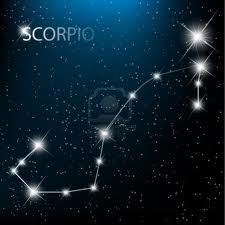
ZODIAC #12 SCORPIO

SCORPIO....The Scorpion....23 October to 22 November.


Your element is Water and your quality is Fixed.  As a Scorpio you are the most intense and penetrating of the Water signs.  The Water element means you are a feeling type, emotionally driven, seeking financial security, emotional satisfaction and creative release.

Being the fixed Water sign means you specialise in holding patterns and fixed emotions  You are capable of intense devotion and intense dislikes, obsessions that help and sometimes harm you.  No shades of grey but plenty of white-hot passions and sometimes black moods, stir Scorpio's deep heart.  You are the eighth sign, the sign of the hidden mysteries, your key phrase "I transform".

Your Planetary Ruler is MARS : Planet of Vital Energy.

Your two ruling planets, the traditional Mars and the modern ruler Pluto both represent power and energy.  Intense emotional connections, psychological penetration and a strong sense of purpose are the direction that your Water flows.  In ancient Arabic astrology "scorpio is of cold and humid nature" and "its angel holds the keys of the creation of fire."  Your speciality is going beneath the surface, stoking the fires from a deep hidden place   In the body Scorpio rules the bladder, colon, prostate gland, urinary system and the male and female sexual organs.  You don't simply simmer - you positively steam!

Mars represents passion and vital energy.  Pluto represents the interlinked cycles of life and death.  The special message they carry for Scorpio is the secret of conserving and transmuting vital energy.

Well this is one star sign I find really fascinating and I am disappointed I can't think of anyone I know or have known who was born under this sign.  Perhaps this is your star sign....is this you?

As mentioned previously these are extracts from Astrology with Christine Broadbent and if anyone should want further information the website is http://astrologyspot.com.au.

I hope you have enjoyed finding out whether or not you, your family or friends are true to your star sign.  It's amazing how often the description seems spot on but there are so many millions born under each star sign it is improbable they would all be the same but perhaps just variations on a theme.


Tuesday, April 23, 2013

ZODIAC (11) VIRGO

VIRGO...The Virgin...23 August to 22 September (my lifelong friend who passed away a few years ago was born under this sign.  I will be interested to see if this describes her although having been born on the cusp this may not be the case.).


Virgo your element is Earth and your quality is mutable.  You are the most mentally oriented Earth sign, ruled by messenger Mercury.  The Earth element means you are a sensate type, motivated by practical goals.

As the mutable Earth sign, you are able to juggle many different facts and details at once and usually manage them all.  Able to shift and change readily, 'mutability' is the basis of your management skills.  Virgo can be most neat and organised or chaotic and messy, but there will always be some corner of your home, which shows your obsession with order.  You are most happy when able to serve your ambitions and the people you love, but also able to keep time for yourself in your busy schedule.  Sixth sign of the zodiac, your key phrase is "I analyse".

Your Planetary Ruler is MERCURY : Planet of the Mind

Analysing details and making perfect sense of them, reaching goals through careful management of time and energy - these activities make you the sign of the earthy harvest.  In ancient Arabic astrology Virgo is "of cold and dry nature (terrestrial)" and your angel "rules the bodies...and in particular the human body".  Mercury is associated with short journeys, with intelligence, with the ability to reason and analyse.  Mercury rules both Virgo and Gemini and Virgo is the 'night sign' of Mercury.  In the body Virgo rules the intestines, digestive organs and bowels.  Your key to good health is developing the ability to put worries and concerns aside at the end of the day and listening to your digestion as an aid to appropriate diet.

Mercury represents the dexterity of the mind and the ability to read people.  His special message for Virgo is to serenely do your work in the world, while trusting that others too can carry the load.

Did this describe my friend?  Well, 'chaotic and messy' is spot on and she was always trying to decide what made other people tick but I'm not sure if she had the ability to accurately read people or not.  I do know that she had a wonderful sense of humour and we had so many good laughs together and I miss her.  How about you?  Were you born under this star sign?

Monday, April 22, 2013

SHINGLES...A VERY NASTY EXPERIENCE

I had previously considered putting this subject on my blog but it is not a very pleasant one and yet one that does exist and Delores on 'the feathered nest' used it in her aging A-Z series so instead of writing reams about it on her page I decided I'd use it here.

I contracted chicken pox in 1957 when my daughter was nearly two and I was pregnant with my son.  I could not go to bed as I had a husband (the first one who was no help at all but we won't go into that), a toddler and a house to look after but I recovered quite well and thought no more about it....until:

I contracted shingles in July, 2010.  It began with a few small blistery type lumps on my forehead from which my GP took a few swabs and sent them off to pathology.  He put me on antibiotics because he was uncertain what the problem was and I feel he may have been thinking of one of the golden staph infections.

I suggested shingles so on the 2nd day he put me on the medication to help prevent them progressing too far.  We may have left it a tad late because the rash spread down the right side of my face and although this photo is disgusting it will give you some idea of how bad I looked.


Sorry to do that to you and I made the picture as small as I could.  I may not be a raving beauty at the best of times but I was not a pretty sight at all and yet my wonderful other half treated me as though my face didn't look like something out of a horror move and he helped as much as he could to make me feel 'normal'.

The rash spread down the side of my face and there was even one spot just above my mouth. I didn't scratch and yet I have white scars on my forehead so now have to make sure I have a fringe to cover them.  My right eye fortunately didn't get an infection in it (the medication may have helped there) but that side of my face swelled so much the doctor put me on cortisone tablets to help take the swelling down.  It didn't go down completely so now one side of my face is permanently puffier than the other.

I am very fortunate that I don't have continuing neuralgia which apparently can go on being painful for years after the rash has gone.  I do have some strange little sensations at times on the right side of my forehead and there is a rough area where I think there should have been blisters which never eventuated.  That area sometimes feels a bit tight and uncomfortable but fortunately is not really painful.

Although I believe it is not 100% reliable, I am wondering should I suggest having the vaccine that is available as my dermatologist told me recently his mother had had shingles twice.  That is something I could well do without so I may mention the vaccine next time I visit my GP.  Perhaps I did ask him back in 2010 and was told 'no'?

Unfortunately the double lot of antibiotics caused other problems even though I didn't take the full course of either once the problem was confirmed as shingles.  I just needed an attack of thrush following on the above but that's what antibiotics can do to us.  I also had a bladder infection which seemed linked to the shingles as well so more antibiotics.  2010...a year to forget until 2011 when I dislocated my left shoulder.....another story there?  No.   I think I'll leave it for now.

ZODIAC #10 CANCER

CANCER...The Crab...22 June to 22 July (my lovely daughter-in-law was born under this sign).


 Cancer, your element is Water and your quality is 'cardinal'.  As the most driven Water sign, you take charge of heart matters, home matters and business matters with organic ease.  The Water element means you are a Feeling Type, physically attuned, sensitive by nature, with emotional insight and healing potential.


'Cardinal' means you are a mover and shakers, driven by a rush of feeling-oriented energy.  Your feelings are expansive and your awareness of people's needs, of moods and atmospheres, make it easy for you to take charge by giving people what they need.  Your way of pushing things to happen is a very subtle way, working on emotions.  Your sensitivity can also pull you away from people. sending you scuttling for a sea cave, beset by fears and worries or simply in a deep Moon-wane.  You are happiest when protecting the people and home you love, while using your natural gifts in a creatively satisfying way.  You are the 'mother' of the zodiac, the fourth sign and your key phrase "I nuture".

Your Planetary Ruler:  MOON : Planet of Feeling

Lavishing attention on those you love and obeying the impulses of your heart, keeps you on the move.  In ancient Arabic astrology Cancer is "of cold and humid nature" and "It's angel holds the keys of the creation of the world."  Being the moon's own sign you keep your psychic antenna in constant use and tend to wax and wane.  Emotionally absorbent around other people, and driven to achieve your goals, you need regular rest.  If like the Moon you could retreat every month as the Moon wanes until after the 'black' New Moon, your moods and general health would benefit greatly.  Since life's demands make this difficult, just easing off the pressure during those low energy Moon times and getting some solitude, will restore your creative spark.  Emotional insight is the Moon's gift and constant reponsiveness gets heavy, so never feel guilty about time out.  The parts of the body ruled by Cancer are the stomach, breasts, diaphragm, womb, ribs and abdominal organs.  Sometimes sensitive to food allergies and often sensitive to hormonal shifts, Cancer is happiest and healthiest with a simple well-planned diet and a gentle, supportive home atmosphere.

The Moon represnets the receptive flow of life, the mediator of the human heart.  Her special message for Caner is to honour your own truth and trust your organic wisdom.

My daughter-in-law is a wonderful home maker but also has a very important bank job so an all rounder.  She certainly protects her home and the people she loves.  She puts up with my son better than anyone else could and they've now been wed for 28 years.  If you were born under this star sign is this you?

Extracts from Astrology with Christine Broadbent.