With the take-over of Bouchers, mum once again went job hunting.
Excerpt from 'THE CLOCK OF TIME' by Gertrude Ruston. (pp 162-164)
"A.P.T. Shipping
I decided not to stay after the take over of Bouchers by Brisbane and Wunderlich, so I once again had to look for a paid position and I decided to visit an employment agent who dealt with top bracket jobs. He sent me along at once to see the Managing Director of a shipping firm, A.P.T. Shipping, who were then in Hay Street, Perth.
My good fairy must have been looking after me as Mr Burnell wanted somebody reliable and mature to do his work and that of the Board. I was then in my sixties and found the shipping jargon a little difficult for a while, so I often stayed back at night to do a little private swatting.
At that time Telex was just becoming known and Mr Burnell brought one into the office as its services were ideal for ETA (expected time of arrival) and ETD (expected time of departure) of ships to and from various ports. The machine is fascinating as while the operator types, perhaps as far away as the other end of the world, the message and answer appears on the Telex screen. It is essential to be accurate because time and words are charged for.
Mr Burnell engaged a woman to be trained at the G.P.O., to operate the machine, but she had only been in the office a few days when she was taken ill and, as head lady, it fell to me to work the Telex without instruction, having only seen the trained operator used it for a very short time. I contacted the G.P.O. and found it was possible to be connected for 15 minutes training time after busy periods in the evening, and they did not charge for this service. In that way I learned how to get in contact with other offices at home and overseas as well as the machine's peculiarities, and was able to carry on until the trained operator returned.
I was with the A.P.T. for about five years and it was an enjoyable period, I was responsible for preparing lunch for Board meetings and found the members extremely pleasant.
Captains of the various ships came into the office and there were times when we were able to go aboard by invitation. It was a Norwegian Line known as "Kunutsen" and the owner himself made an occasional visit. I remember one special occasion when the staff members were invited to a meal on board and we all thoroughly enjoyed the smorgasbord. On one occasion I had to buy a special cage for one of the captains for his canary, so that his pet would be safe in rough weather.
Meantime I carried on as Hon. Secretary of the Council of Social Service and Hon. Secretary/Treasurer of the Swan River Conservation Committee as my voluntary work, enjoying membership of the Soroptimist Club of Perth for recreation.
I had heard a rumour that A.P.T. were about to retire some of their staff at the age of 70 and, although I was assured that this did not apply to me, I realised that my period of employment by a commercial firm might be drawing to a close.
With my knowledge of social welfare I decided to watch for an opening in that field, and when one occurred I tendered my resignation, to Mr Burnell's expressed regret. He gave me a very nice silver Parker pen as a farewell gift." (It was a beautiful fountain pen and I still have it although these days I prefer to use a ballpoint pen. I also have a Parker ballpoint pen that belonged to mum which I still use. It has her name G.W.Ruston engraved on it. I treasure both pens very much. Here is a photo of the two pens I took a couple of minutes ago; you can quite clearly see mum's name engraved on the ballpoint pen. I have had them since 1985).
"The last time I heard from Mr Burnell was when he sent me a letter of congratulations on my being included in the book 'REFLECTIONS' containing profiles of a hundred and fifty women who helped make Western Australian history during its first 150 years. (That book was of course published in 1979).
Monday, April 6, 2015
Sunday, April 5, 2015
SOMETHING ENTIRELY DIFFERENT
After my marriage and her separation from dad, mum's life took a sudden and quite different turn. How she coped with that change she tells in Chapter Five of her book:
Excerpt from 'THE CLOCK OF TIME' by Gertrude Ruston. (pp 157-162)
"Re-entry to the Commercial World"
After my husband and I separated (my words...not mum's) "I moved to a flat opposite Government House in Adelaide Terrace in the city. At that time I was still closely associated as President of the Slow Learning Children's Group, and it was in my flat at 22 St George's Terrace, that I started the Fun Club for the older young people.
Having to now find full time employment, I studied the daily papers and answered three advertisements which appeared suitable. To my delight I received requests from all of them asking me to telephone and make an appointment for an interview.
One advert was for a hotel receptionist, the second for a shorthand typist in a typewriting office, and the the third for a confidential secretary to the General Manager and Secretary of Bouchers Industries in Scarborough Beach Road in Osborne Park.
Of the three the last named appealed to me and I rang them for an early appointment, and felt quite nervous as I waited for the interview. I had not given my age but was in my late fifties and knew I might be considered too old for the advertised position.
I was given a shorthand typing test by a woman of about 40 who told me she was retiring from the position of Company Secretary, and that the person taking over from her was man. She asked many questions about my experience and took the details, together with the result of my test, into the office of the General Manager, Mr Herbert Freeman.
After a few minutes I was asked to go into Mr Freeman's office and found him to be of late middle age and of great charm of manner. He spoke excellent English but with a slight accent which I recognised as either Austrian or German. He was impressed by the fact that, in my young days, I had been conversant with French and German, and asked if I would be able and willing to correct any errors he might make in dictation. I explained that I was out of practice but thought I would be able to cope with that task.
Between Mr Freeman and I, as there had been between Mrs Rischbieth and I, there was an instant feeling that we could work together, and he engaged me right away to commence work the following week. I was given a private office of my own and strict confidentiality was the order of the day.
Mr Arthur Jones, the Company Secretary, was a highly qualified certified accountant from the old country, and was very pleasant to work with, so everything went well for about five years.
Looking back I remember one particular time at Bouchers when Mr Jones was taken very ill with pneumonia, and the pressure was exceedingly heavy on Mr Freeman and myself. In order to cope with Board Meetings and special business I was made Assistant Secretary to the Company during Mr Jones' absence and remained late practically every night to cover the work.
Mr Freeman pleaded with me not to break down on him and, in order to catch up with sleep and rest, I booked into the Scarborough Hotel for weekends and made arrangements for them to bring me meals to my room. The members of staff were excellent, bringing menus and meals to me, and I read and slept over the weekends, leaving feeling thoroughly rested and refreshed on Monday mornings, able to face the tasks ahead.
Arthur Jones was nursed excellently at home by his wife Alice and, after a long spell of serious illness, he returned to resume his duties. I was told later that both the Accountant and Chief Clerk were very much annoyed that I, and not they, had been made Assistant Secretary at the time of Mr Jones' illness, but I doubt if either of them would have put in the required extra hours of service that I gave without compensation.
Mr and Mrs Freeman had one son and one daughter. The son, Kenneth, was a brilliant student, and when he left university he took with him every possible bursary and honour. He is now one of Australia's leading physicists. While still a student his father used to encourage him to assist with all sorts of tasks at Bouchers, sometimes helping me in my office during holiday periods.
The daughter Ann was her father's pet, and when she was young he always took her to the Royal Show on Show Day, where they would both thoroughly enjoy themselves. Ann became an Occupational Therapist. She is now married and has several very fine sons.
Alice and Arthur Jones have a daughter and two sons, all married and doing well. Arthur has prospered considerably by his own efforts since leaving Bouchers and has now retired. He and Alice have been able to take several overseas trips during the last few years despite some periods of ill health.
Suddenly at Bouchers, after about five years, we were confronted with a takeover bid by Brisbane Wunderlich and Company. They descended on us without warning, although the Board members had obviously agreed to the takeover.
They advised Mr Freeman that they would no longer require his services as they were bringing in their own Manager. Fortunately Mr Freeman had an agreement which guaranteed him suitable compensation.
Neither I nor Mr Jones intended to remain. As Company Secretary, Mr Jones had been asked to stay, but felt it would not be in his own best interest to do so. He agreed to remain for short period in order to introduce the incoming Secretary to the affairs of the Company. He asked me to remain with him and defer giving in my notice until he too was ready to resign, to which I agree. When I did intimate that I was leaving the new Manager said he had hoped that I would stay with them and asked me to reconsider. No doubt I would have been useful to them because I had so much knowledge. but I certainly could not have worked with the incoming brash young Secretary.
On the day of their arrival for the takeover they ruthlessly dispensed with the services of foremen and leading hands who had been with the company for many years, giving them money instead of notice. The poor men were terribly shocked, and I grieved for them having to go home to tell their wives that they no longer had a job. In due course the Social Club put on a farewell party for Mr Freeman and others that were leaving. All the old staff of Bouchers Industries were present including the cleaners with their husbands and wives. (This is a photo I have of mum with her boss Mr Freeman at the farewell dinner. It was in about 1959 and mum was then about 61 or 62):
It was a sad occasion and I was asked to speak on behalf of the female staff. I remember saying it was like coming to the end of a voyage and the Captain and others were leaving the ship. We all hoped the rest of life's journey would be happy for everybody.
In this photo (scanned from mum's book) are Mr and Mrs Jones, mum, Mr Freeman and other guests:
Mrs Freeman did not attend. She had a bad heart and feared the emotion of such a farewell would be too much for her. I was seated at the top table with Mr Freeman. Mr and Mrs Jones and other staff seniors, and I have photographs taken of some of those present. Unfortunately Mrs Freeman died of a heart attack some years ago.
The Social Club gave Mr Jones and me a little farewell in the office when our time came for leaving, an we each received a gift of remembrance. Alice and Arthur Jones and I remained friends during the years, and my last contact with them was the receipt of a card sent by them from Spain in 1981.
Both my bosses gave me excellent references, and the one from Mr Freeman was so good that a subsequent employer suggested that I should have it framed and hung on the wall.
Late in life Herbert Freeman went to university and, at the age of seventy-three, took his Ph.D., but developed a distressing illness from which he died.
I knew Mr and Mrs Jones quite well. Mr Jones was a cymbidium orchid enthusiast who encouraged mum to also grow a number of these orchids of which she was very proud. Mrs Jones was artistic and gave mum a painting showing an coastal area south of Perth and also a painted plate. I now have both items with the painting hanging in our living room. Eventually mum gave me her orchids but we unfortunately never had any success with them and they all went to that great orchid heaven in the sky.
Excerpt from 'THE CLOCK OF TIME' by Gertrude Ruston. (pp 157-162)
"Re-entry to the Commercial World"
After my husband and I separated (my words...not mum's) "I moved to a flat opposite Government House in Adelaide Terrace in the city. At that time I was still closely associated as President of the Slow Learning Children's Group, and it was in my flat at 22 St George's Terrace, that I started the Fun Club for the older young people.
Having to now find full time employment, I studied the daily papers and answered three advertisements which appeared suitable. To my delight I received requests from all of them asking me to telephone and make an appointment for an interview.
One advert was for a hotel receptionist, the second for a shorthand typist in a typewriting office, and the the third for a confidential secretary to the General Manager and Secretary of Bouchers Industries in Scarborough Beach Road in Osborne Park.
Of the three the last named appealed to me and I rang them for an early appointment, and felt quite nervous as I waited for the interview. I had not given my age but was in my late fifties and knew I might be considered too old for the advertised position.
I was given a shorthand typing test by a woman of about 40 who told me she was retiring from the position of Company Secretary, and that the person taking over from her was man. She asked many questions about my experience and took the details, together with the result of my test, into the office of the General Manager, Mr Herbert Freeman.
After a few minutes I was asked to go into Mr Freeman's office and found him to be of late middle age and of great charm of manner. He spoke excellent English but with a slight accent which I recognised as either Austrian or German. He was impressed by the fact that, in my young days, I had been conversant with French and German, and asked if I would be able and willing to correct any errors he might make in dictation. I explained that I was out of practice but thought I would be able to cope with that task.
Between Mr Freeman and I, as there had been between Mrs Rischbieth and I, there was an instant feeling that we could work together, and he engaged me right away to commence work the following week. I was given a private office of my own and strict confidentiality was the order of the day.
Mr Arthur Jones, the Company Secretary, was a highly qualified certified accountant from the old country, and was very pleasant to work with, so everything went well for about five years.
Looking back I remember one particular time at Bouchers when Mr Jones was taken very ill with pneumonia, and the pressure was exceedingly heavy on Mr Freeman and myself. In order to cope with Board Meetings and special business I was made Assistant Secretary to the Company during Mr Jones' absence and remained late practically every night to cover the work.
Mr Freeman pleaded with me not to break down on him and, in order to catch up with sleep and rest, I booked into the Scarborough Hotel for weekends and made arrangements for them to bring me meals to my room. The members of staff were excellent, bringing menus and meals to me, and I read and slept over the weekends, leaving feeling thoroughly rested and refreshed on Monday mornings, able to face the tasks ahead.
Arthur Jones was nursed excellently at home by his wife Alice and, after a long spell of serious illness, he returned to resume his duties. I was told later that both the Accountant and Chief Clerk were very much annoyed that I, and not they, had been made Assistant Secretary at the time of Mr Jones' illness, but I doubt if either of them would have put in the required extra hours of service that I gave without compensation.
Mr and Mrs Freeman had one son and one daughter. The son, Kenneth, was a brilliant student, and when he left university he took with him every possible bursary and honour. He is now one of Australia's leading physicists. While still a student his father used to encourage him to assist with all sorts of tasks at Bouchers, sometimes helping me in my office during holiday periods.
The daughter Ann was her father's pet, and when she was young he always took her to the Royal Show on Show Day, where they would both thoroughly enjoy themselves. Ann became an Occupational Therapist. She is now married and has several very fine sons.
Alice and Arthur Jones have a daughter and two sons, all married and doing well. Arthur has prospered considerably by his own efforts since leaving Bouchers and has now retired. He and Alice have been able to take several overseas trips during the last few years despite some periods of ill health.
Suddenly at Bouchers, after about five years, we were confronted with a takeover bid by Brisbane Wunderlich and Company. They descended on us without warning, although the Board members had obviously agreed to the takeover.
They advised Mr Freeman that they would no longer require his services as they were bringing in their own Manager. Fortunately Mr Freeman had an agreement which guaranteed him suitable compensation.
Neither I nor Mr Jones intended to remain. As Company Secretary, Mr Jones had been asked to stay, but felt it would not be in his own best interest to do so. He agreed to remain for short period in order to introduce the incoming Secretary to the affairs of the Company. He asked me to remain with him and defer giving in my notice until he too was ready to resign, to which I agree. When I did intimate that I was leaving the new Manager said he had hoped that I would stay with them and asked me to reconsider. No doubt I would have been useful to them because I had so much knowledge. but I certainly could not have worked with the incoming brash young Secretary.
On the day of their arrival for the takeover they ruthlessly dispensed with the services of foremen and leading hands who had been with the company for many years, giving them money instead of notice. The poor men were terribly shocked, and I grieved for them having to go home to tell their wives that they no longer had a job. In due course the Social Club put on a farewell party for Mr Freeman and others that were leaving. All the old staff of Bouchers Industries were present including the cleaners with their husbands and wives. (This is a photo I have of mum with her boss Mr Freeman at the farewell dinner. It was in about 1959 and mum was then about 61 or 62):
It was a sad occasion and I was asked to speak on behalf of the female staff. I remember saying it was like coming to the end of a voyage and the Captain and others were leaving the ship. We all hoped the rest of life's journey would be happy for everybody.
In this photo (scanned from mum's book) are Mr and Mrs Jones, mum, Mr Freeman and other guests:
Mrs Freeman did not attend. She had a bad heart and feared the emotion of such a farewell would be too much for her. I was seated at the top table with Mr Freeman. Mr and Mrs Jones and other staff seniors, and I have photographs taken of some of those present. Unfortunately Mrs Freeman died of a heart attack some years ago.
The Social Club gave Mr Jones and me a little farewell in the office when our time came for leaving, an we each received a gift of remembrance. Alice and Arthur Jones and I remained friends during the years, and my last contact with them was the receipt of a card sent by them from Spain in 1981.
Both my bosses gave me excellent references, and the one from Mr Freeman was so good that a subsequent employer suggested that I should have it framed and hung on the wall.
Late in life Herbert Freeman went to university and, at the age of seventy-three, took his Ph.D., but developed a distressing illness from which he died.
I knew Mr and Mrs Jones quite well. Mr Jones was a cymbidium orchid enthusiast who encouraged mum to also grow a number of these orchids of which she was very proud. Mrs Jones was artistic and gave mum a painting showing an coastal area south of Perth and also a painted plate. I now have both items with the painting hanging in our living room. Eventually mum gave me her orchids but we unfortunately never had any success with them and they all went to that great orchid heaven in the sky.
HAPPY EASTER ONE AND ALL
Many years ago when I was a child Easter, as I remember it, was always associated with chickens, you know, those delightful little fluffy chicks:
In later years it seemed the Easter bunny took over in all shapes and sizes:
and here in Australia there is even our own little bilby made in chocolate:
This is what that chap looks like in real life:
What started all this off you ask? Just the fact that I wanted to wish everyone a very happy, peaceful and safe Easter and do watch out for those wicked Easter bunnies!!!
H A V E A H A P P Y E A S T E R
In later years it seemed the Easter bunny took over in all shapes and sizes:
and here in Australia there is even our own little bilby made in chocolate:
This is what that chap looks like in real life:
What started all this off you ask? Just the fact that I wanted to wish everyone a very happy, peaceful and safe Easter and do watch out for those wicked Easter bunnies!!!
H A V E A H A P P Y E A S T E R
Saturday, April 4, 2015
CIVILIAN WIDOWS
Excerpt from 'THE CLOCK OF TIME' by Gertrude Ruston. (pp 154-156)
"Formation of Assocation of Civilian Widows
Mrs Rischbieth considered that help should be sought for civilian widows similar to that given to war widows under "Legacy". and to this end the Guilds called a meeting in 1953 in the Grand Theatre Building in Murray Street, Perth, with the President, Mrs W. Kastner, in the chair.
Attention was drawn to the fact that help was particularly urgent where there were growing boys who needed a man's interest.
Mr Eric Benjamin of the Guidance Branch was most helpful in planning the foundation of this association and obtained the support of Apex and Rotary Clubs which has proved invaluable.
Widowed members of the Guilds became the first officers of the new organisation in order to give it stability, and it has grown and flourished.
Mrs Ivy Kent became the first President, Mrs I. Evers the first Hon. Treasurer, supported by Mrs Rischbieth and Mrs Evans, all of whom were well-known women in the community.
Mrs Kent fought and worked with inspired determination with the result that a national body was formed five years later. She remained the State President until she was compelled to retire due to ill health in 1971. In 1959 she was elected National President and later, National Life Governor.
During the war Ivy Kent founded a club for neglected girls, and was a foundation member of the National Fitness Council. She was the first woman member of the Australian Broadcasting Commission (representing W.A.) from 1944 to 1951.
She was also a member of the Lotteries Commission and the Adult Education Board. She was a Justice of the Peace and decorated with the M.B.W., in 1968 for her services to women and children.
As State Secretary of the Guilds at this time I helped to organise the first meeting, and was taken to see number 40 Ventnor Avenue in West Perth to confer, with others. on the proposed purchase of that building which became the first headquarters of the Association of Civilian Widows in W.A. The Apex Club stood by and assisted A.C.W. for many years.
I had the pleasure of taking Mrs Frank, a leading officer of A.C.W. from the eastern states, to visit Mrs Rischbieth in her home one evening. Had it not been for Mrs Bessie Rischbieth so many of these community needs would not have come to fruition.
Changes in my personal life at this time after my daughter married and my husband and I separated, made it necessary for me to obtain another position which would pay me a reasonable salary. The Guilds gave me a farewell function and presented me with a very nice writing set as a parting gift.
I promised Mrs Rischbieth that I would become a Guild member and continue my association with the organisation, and I have kept my word in that regard.
The Guilds truly carry on their service, closely watching legislation and social needs. The following is surely an apt memorial to the past and present members :-
'THE SERVICE I RENDER TO OTHERS PAYS MY RENT FOR MY LIFE ON EARTH"
On checking "Trove" I found a public notice on in the 'Western Australian newspaper of 1 October, 1954 showing the results of a raffle held for the Civilian Widows Association, which shows the Assocation was getting on well. It is great to realise that this worthwhile association began with its roots in Western Australia.
Once again I have changed mum's words slightly. In her book the words in the third last paragraph read "after my daughter married and I lost my husband". Mum did not 'lose' her husband but decided they should separate after I had married. I feel she may have waited until I was settled in my married life although of that I can not be sure. Life can take strange turns without warning and we have to accept them. When the separation occurred it took me by complete surprise and in later life had repercussions for me and mine but that, as I've said before, is another story.
"Formation of Assocation of Civilian Widows
Mrs Rischbieth considered that help should be sought for civilian widows similar to that given to war widows under "Legacy". and to this end the Guilds called a meeting in 1953 in the Grand Theatre Building in Murray Street, Perth, with the President, Mrs W. Kastner, in the chair.
Attention was drawn to the fact that help was particularly urgent where there were growing boys who needed a man's interest.
Mr Eric Benjamin of the Guidance Branch was most helpful in planning the foundation of this association and obtained the support of Apex and Rotary Clubs which has proved invaluable.
Widowed members of the Guilds became the first officers of the new organisation in order to give it stability, and it has grown and flourished.
Mrs Ivy Kent became the first President, Mrs I. Evers the first Hon. Treasurer, supported by Mrs Rischbieth and Mrs Evans, all of whom were well-known women in the community.
Mrs Kent fought and worked with inspired determination with the result that a national body was formed five years later. She remained the State President until she was compelled to retire due to ill health in 1971. In 1959 she was elected National President and later, National Life Governor.
During the war Ivy Kent founded a club for neglected girls, and was a foundation member of the National Fitness Council. She was the first woman member of the Australian Broadcasting Commission (representing W.A.) from 1944 to 1951.
She was also a member of the Lotteries Commission and the Adult Education Board. She was a Justice of the Peace and decorated with the M.B.W., in 1968 for her services to women and children.
As State Secretary of the Guilds at this time I helped to organise the first meeting, and was taken to see number 40 Ventnor Avenue in West Perth to confer, with others. on the proposed purchase of that building which became the first headquarters of the Association of Civilian Widows in W.A. The Apex Club stood by and assisted A.C.W. for many years.
I had the pleasure of taking Mrs Frank, a leading officer of A.C.W. from the eastern states, to visit Mrs Rischbieth in her home one evening. Had it not been for Mrs Bessie Rischbieth so many of these community needs would not have come to fruition.
Changes in my personal life at this time after my daughter married and my husband and I separated, made it necessary for me to obtain another position which would pay me a reasonable salary. The Guilds gave me a farewell function and presented me with a very nice writing set as a parting gift.
I promised Mrs Rischbieth that I would become a Guild member and continue my association with the organisation, and I have kept my word in that regard.
The Guilds truly carry on their service, closely watching legislation and social needs. The following is surely an apt memorial to the past and present members :-
'THE SERVICE I RENDER TO OTHERS PAYS MY RENT FOR MY LIFE ON EARTH"
On checking "Trove" I found a public notice on in the 'Western Australian newspaper of 1 October, 1954 showing the results of a raffle held for the Civilian Widows Association, which shows the Assocation was getting on well. It is great to realise that this worthwhile association began with its roots in Western Australia.
Once again I have changed mum's words slightly. In her book the words in the third last paragraph read "after my daughter married and I lost my husband". Mum did not 'lose' her husband but decided they should separate after I had married. I feel she may have waited until I was settled in my married life although of that I can not be sure. Life can take strange turns without warning and we have to accept them. When the separation occurred it took me by complete surprise and in later life had repercussions for me and mine but that, as I've said before, is another story.
Friday, April 3, 2015
MEALS ON WHEELS
Excerpt from 'THE CLOCK OF TIME' by Gertrude Ruston. (pp 153-154)
"Meals on Wheels
During the time I was President of the Soroptimist Club of Perth, one of our members, who was the Superintendent of the Silver Chain District Nursing Association, drew attention to the very real need for some home help to be provided as an addition to the nursing aid given by her service. She asked if the Soroptimist Club of Perth would be prepared to establish some form or home help, as the Silver Chain nurses did not undertake cleaning, washing or cooking and people living alone had a great need of some help.
Members were entirely sympathetic but we were all busy women and, as a new club, it was felt such an undertaking was beyond us. After discussion I asked if the club would allow me to put the request to the Women's Service Guilds, of which I was State Secretary, and I was requested to take that action.
At the next meeting of the Guilds' State Executive the matter was discussed and, although this was not the Guilds' work, it was agreed that a pilot scheme should be conducted by me from the office, with the assistance of Mrs Florence Hummerston and Mrs Gladys Christie." (I got to know Mrs Christie well in later years and have in my possession a lovely small china bowl and china spoon she gave me back in the 1960s).
"We approached Mr Frank Boan for the use of an office on the second floor of Boans Perth Building, and he was kind enough to grant it together with the use of essential furniture. We obtained publicity and people were asked to offer their services or, if in need of help. to seek same at the office in Boans which was manned by Mrs Christie.
After a short trial period it was obvious that there was a definite need for a properly established home help service, and the government was asked for its assistance. The Guilds then handed the project over to Mrs Hummerston, one of the Perth Guild members, and she was assisted by the government in setting up what is known as the League of Home Help.
This has proved a very worthwhile service for the sick and aged, but was not sufficient for the needs of Silver Chain, which eventually started its own Home Help Service when Sister K. Barnes was Superintendent of the Nursing Service.
South Australia started an organisation known as Meals on Wheels, which was due to the efforts of a severely crippled woman in that State, The League of Home Help and Silver Chain had both found there was a definite need for such a service in W.A., and after obtaining all the information possible from South Australia, Mrs Hummerston started Meals on Wheels in association with the League of Home Help.
This marvellous service allows hot meals to be delivered by voluntary car drivers five days a week, for which a nominal fee is charged. Extra meals are delivered on Fridays for the weekend. This scheme has spread to other districts and is run, in some cases, by local Councils.
Many of our local Councils now have very helpful aid for the sick and aged. Our own Cockburn Council has what is known as "Cockburn Care" and once you have proved yourself eligible for help you can have house cleaning, window cleaning, gutter cleaning, gardening and odd jobs done and some people are taken to do their weekly shopping or even taken to medical appointments. It is not expensive as it is government subsidised so well within the means of most pensioners. We have a regular lady who comes in one hour a fortnight to clean and I am always amazed at how much she gets done in that time, plus she is a very delightful English lass who on Tuesday popped in unexpectedly to introduce us to her brother who is here on a visit from England. Every five weeks an Indian gentleman comes in and does our lawns either with a mower or whipper-snipper. Looking outside today I realised it's time I rang them and booked someone to clean our windows too!
"Meals on Wheels
During the time I was President of the Soroptimist Club of Perth, one of our members, who was the Superintendent of the Silver Chain District Nursing Association, drew attention to the very real need for some home help to be provided as an addition to the nursing aid given by her service. She asked if the Soroptimist Club of Perth would be prepared to establish some form or home help, as the Silver Chain nurses did not undertake cleaning, washing or cooking and people living alone had a great need of some help.
Members were entirely sympathetic but we were all busy women and, as a new club, it was felt such an undertaking was beyond us. After discussion I asked if the club would allow me to put the request to the Women's Service Guilds, of which I was State Secretary, and I was requested to take that action.
At the next meeting of the Guilds' State Executive the matter was discussed and, although this was not the Guilds' work, it was agreed that a pilot scheme should be conducted by me from the office, with the assistance of Mrs Florence Hummerston and Mrs Gladys Christie." (I got to know Mrs Christie well in later years and have in my possession a lovely small china bowl and china spoon she gave me back in the 1960s).
"We approached Mr Frank Boan for the use of an office on the second floor of Boans Perth Building, and he was kind enough to grant it together with the use of essential furniture. We obtained publicity and people were asked to offer their services or, if in need of help. to seek same at the office in Boans which was manned by Mrs Christie.
After a short trial period it was obvious that there was a definite need for a properly established home help service, and the government was asked for its assistance. The Guilds then handed the project over to Mrs Hummerston, one of the Perth Guild members, and she was assisted by the government in setting up what is known as the League of Home Help.
This has proved a very worthwhile service for the sick and aged, but was not sufficient for the needs of Silver Chain, which eventually started its own Home Help Service when Sister K. Barnes was Superintendent of the Nursing Service.
South Australia started an organisation known as Meals on Wheels, which was due to the efforts of a severely crippled woman in that State, The League of Home Help and Silver Chain had both found there was a definite need for such a service in W.A., and after obtaining all the information possible from South Australia, Mrs Hummerston started Meals on Wheels in association with the League of Home Help.
This marvellous service allows hot meals to be delivered by voluntary car drivers five days a week, for which a nominal fee is charged. Extra meals are delivered on Fridays for the weekend. This scheme has spread to other districts and is run, in some cases, by local Councils.
Many of our local Councils now have very helpful aid for the sick and aged. Our own Cockburn Council has what is known as "Cockburn Care" and once you have proved yourself eligible for help you can have house cleaning, window cleaning, gutter cleaning, gardening and odd jobs done and some people are taken to do their weekly shopping or even taken to medical appointments. It is not expensive as it is government subsidised so well within the means of most pensioners. We have a regular lady who comes in one hour a fortnight to clean and I am always amazed at how much she gets done in that time, plus she is a very delightful English lass who on Tuesday popped in unexpectedly to introduce us to her brother who is here on a visit from England. Every five weeks an Indian gentleman comes in and does our lawns either with a mower or whipper-snipper. Looking outside today I realised it's time I rang them and booked someone to clean our windows too!
Thursday, April 2, 2015
THE SLCG CONTINUES TO GROW AND FLOURISH
Excerpt from "THE CLOCK OF TIME" by Gertrude Ruston. (pp 150-153)
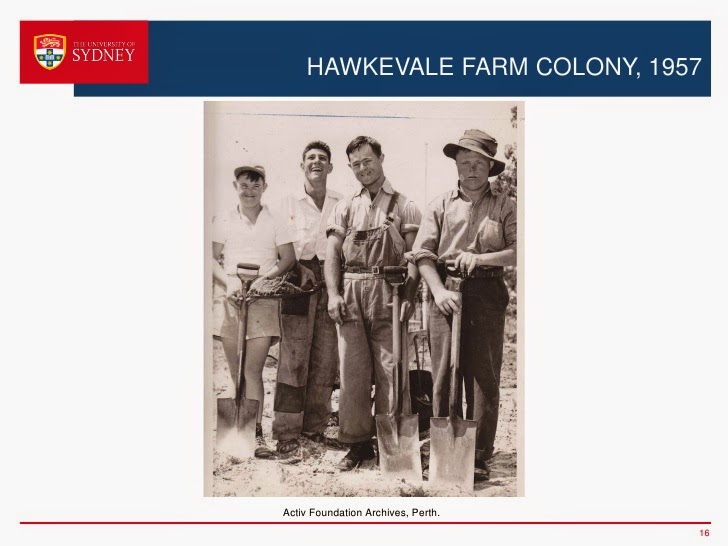
"We soon decided we would need to obtain a permanent home for some of the older intellectually handicapped children, and an areas was acquired for a farm village which was named "Hawkevale" after the Premier the Hon. A.R.G.Hawke.
Two cottage homes were built on this block and, at the suggestion of parents, they were named after Mrs Newton and myself, as the two people who had been most active in putting the SLCG on the map.
The boys became very proud of their cottages, and a little rivalry arose as to whether the trees round one cottage grew better than those round the other.
After some years the first farm village was taken over for extensions to the Perth Airport and another has been acquired and developed. it is still called "Hawkevale" and our two cottages are still so named. There are now four cottages - two for girls and two for boys.
It was nice to be invited to the opening ceremony performed by Sir Paul Hasluck and I was given the seat of honour next to Lady Hasluck (now Dame Alexandra Hasluck) at the top table. The Hon. A.R.G. Hawke was an honoured guest, and the name of the farm village will always remind us of the Premier who gave us our first official support and encouragement. Unfortunately Mrs Newton was ill at the time of the opening and could not attend. (I am not a Labor supporter but have always considered that Mr Hawke was one of the best Premiers W.A. ever had. He was, of course, related to Bob Hawke who was at one time Prime Minister of Australia; an uncle I think).
This is Sir Paul Hasluck:
The latest idea is to encourage a number of young people, who have the ability, to live independently, under supervision, in small groups. The SLCG is still developing and expanding, while the knowledge of mental retardation today is beyond anything we had anticipated in the early days. SLCG is now one of the largest welfare bodies in this State, and caters for a very large number of various types of intellectually handicapped people.
I resigned from the position of President in 1954 and was made an Hon. Life Member. I carried on the Fun Club for its first nine years. As a testimonial I have a bound copy of the early newsletters and an Honorary Life Certificate. I have also been honoured as Vice-Patron of the SLCG.
Photographs of the original officers were taken some time ago and were to be hung in SLCG Headquarters. I have not seen mine and I understand none of them have been hung to date. (I wonder if they ever did get hung??)
I hunted around and was thrilled to find two pictures relating to Hawkevale Village in 1957. You can see them above.
"We soon decided we would need to obtain a permanent home for some of the older intellectually handicapped children, and an areas was acquired for a farm village which was named "Hawkevale" after the Premier the Hon. A.R.G.Hawke.
Two cottage homes were built on this block and, at the suggestion of parents, they were named after Mrs Newton and myself, as the two people who had been most active in putting the SLCG on the map.
The boys became very proud of their cottages, and a little rivalry arose as to whether the trees round one cottage grew better than those round the other.
After some years the first farm village was taken over for extensions to the Perth Airport and another has been acquired and developed. it is still called "Hawkevale" and our two cottages are still so named. There are now four cottages - two for girls and two for boys.
It was nice to be invited to the opening ceremony performed by Sir Paul Hasluck and I was given the seat of honour next to Lady Hasluck (now Dame Alexandra Hasluck) at the top table. The Hon. A.R.G. Hawke was an honoured guest, and the name of the farm village will always remind us of the Premier who gave us our first official support and encouragement. Unfortunately Mrs Newton was ill at the time of the opening and could not attend. (I am not a Labor supporter but have always considered that Mr Hawke was one of the best Premiers W.A. ever had. He was, of course, related to Bob Hawke who was at one time Prime Minister of Australia; an uncle I think).
This is Sir Paul Hasluck:

The latest idea is to encourage a number of young people, who have the ability, to live independently, under supervision, in small groups. The SLCG is still developing and expanding, while the knowledge of mental retardation today is beyond anything we had anticipated in the early days. SLCG is now one of the largest welfare bodies in this State, and caters for a very large number of various types of intellectually handicapped people.
I resigned from the position of President in 1954 and was made an Hon. Life Member. I carried on the Fun Club for its first nine years. As a testimonial I have a bound copy of the early newsletters and an Honorary Life Certificate. I have also been honoured as Vice-Patron of the SLCG.
Photographs of the original officers were taken some time ago and were to be hung in SLCG Headquarters. I have not seen mine and I understand none of them have been hung to date. (I wonder if they ever did get hung??)
I hunted around and was thrilled to find two pictures relating to Hawkevale Village in 1957. You can see them above.
Wednesday, April 1, 2015
GREAT TO BE PROVEN CORRECT (or was I?)
Watching the news on TV today something I've been saying for some time seems to have been proven correct. There is sure to be a lot more said on the subject but so far this is the verdict.
I am sure enough of you have 'heard' me complaining about my osteo arthritis (have had two hip replacements) and in particularly my very, very bad back and a knee that also doesn't like me. So bad in fact, that standing for long or walking any worthwhile distance is a thing of the past. I use a stick in the house and a walker when I do have to go to the shops but years ago I was put on to Pandadol Osteo (6 tablets daily so as not exceed the 4,000mg which is considered a safe daily dose). I have been taking them religiously and....hoping.
In the advertisement for this produce it states that it may give up to a 24 hour relief from pain from osteo arthritis. It perhaps omits to say how serious the arthritis is before the Panadol Ostoer ceases to have any, or little, effect. Modern advertising can be very confusing and a times rather misleading.
My daughter and I have often discussed the use of paracetamol and decided it may help the tiny aches and pains but, on the whole, does very little to dull severe pain. I have continued taking it in the hope that perhaps the placebo effect may work.....you know....mind over matter!! I sometimes think it may help my hands but perhaps the exercise I do with them on my keyboard and crocheting does more good as it keeps them active.
Apparently a big study has been done here in Australia and those taking paracetamol for back pain and osteo arthritis were no better off then those taking placebos and, of course, paracetamol can damage one's liver over time. I think the last blood test I had showed my liver not doing too badly but is it worth the risk if the tablets I take do little to ease the pain?
The result of this recent study was that many people suffer back pain during their lifetime but 10% become incapacitated as a result of their back pain, which is of course very true. The part of the result that didn't sit well with me of course was that the alternative to using paracetamol ..... people could lose weight (not easy when you can't move much), and exercise (also not easy etc etc).
About 10 years or more back I remember having a discussion about medications with my orthopaedic surgeon who said he considered any medication that kept you alive should be taken regularly but most others (and I feel he also included alternative medications in this) could be dangerous and quite often unnecessary. He then went on to say that to date (remember this was back in about 2003/4) nobody knew the outcome re the constant use of PARACETAMOL!! We now are told it is possibly useless anyway and could be dangerous.
I rest my case....I wonder how many of you take paracetamol for different types of pain. Do you actually find that it does help reduce pain? I would be very interested in your opinion.
I am sure enough of you have 'heard' me complaining about my osteo arthritis (have had two hip replacements) and in particularly my very, very bad back and a knee that also doesn't like me. So bad in fact, that standing for long or walking any worthwhile distance is a thing of the past. I use a stick in the house and a walker when I do have to go to the shops but years ago I was put on to Pandadol Osteo (6 tablets daily so as not exceed the 4,000mg which is considered a safe daily dose). I have been taking them religiously and....hoping.
In the advertisement for this produce it states that it may give up to a 24 hour relief from pain from osteo arthritis. It perhaps omits to say how serious the arthritis is before the Panadol Ostoer ceases to have any, or little, effect. Modern advertising can be very confusing and a times rather misleading.
My daughter and I have often discussed the use of paracetamol and decided it may help the tiny aches and pains but, on the whole, does very little to dull severe pain. I have continued taking it in the hope that perhaps the placebo effect may work.....you know....mind over matter!! I sometimes think it may help my hands but perhaps the exercise I do with them on my keyboard and crocheting does more good as it keeps them active.
Apparently a big study has been done here in Australia and those taking paracetamol for back pain and osteo arthritis were no better off then those taking placebos and, of course, paracetamol can damage one's liver over time. I think the last blood test I had showed my liver not doing too badly but is it worth the risk if the tablets I take do little to ease the pain?
The result of this recent study was that many people suffer back pain during their lifetime but 10% become incapacitated as a result of their back pain, which is of course very true. The part of the result that didn't sit well with me of course was that the alternative to using paracetamol ..... people could lose weight (not easy when you can't move much), and exercise (also not easy etc etc).
About 10 years or more back I remember having a discussion about medications with my orthopaedic surgeon who said he considered any medication that kept you alive should be taken regularly but most others (and I feel he also included alternative medications in this) could be dangerous and quite often unnecessary. He then went on to say that to date (remember this was back in about 2003/4) nobody knew the outcome re the constant use of PARACETAMOL!! We now are told it is possibly useless anyway and could be dangerous.
I rest my case....I wonder how many of you take paracetamol for different types of pain. Do you actually find that it does help reduce pain? I would be very interested in your opinion.
Subscribe to:
Posts (Atom)