Wednesday, May 8, 2013

L (Part 2) is for LYNX


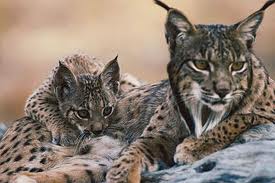
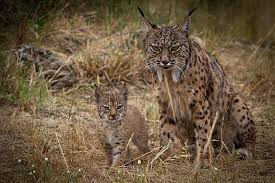
The conservation status of the Iberian Lynx (Lynx pardinus) is CRITICALLY ENDANGERED.  The Iberian Lynx and the Eurasian Lynx are very similar in appearance except the Iberian Lynx is about half the size.  They have a body length of between 85-110 cms (34-43 inches), a tail length of approximately 13 cms (5 inches) and they weigh between 10-13 kgs (22-29 lbs).


Their coat is a grey-brown colour with distinctive black markings and a light coloured underside.  They have tufted ears, long whiskers and wide feet.  The Iberian lynx is nocturnal but during the winter months it is active during the day.

The Iberian lynx inhabits the open forests and thickets of the Iberian Peninsula in South West Europe.  They are solitary animals.  The territories of the males often overlap the territories of several female, and they mark these territories by urinating on trees and rocks.


The Iberian lynx is carnivorous and its diet mainly consists of small mammals, mainly rabbits and birds.  If rabbits are scarce deer and mouflon (the mouflon is a subspecies group of the wild sheep Ovis aries) are hunted.

After a gestation period of about 60 days a litter of 2-3 kittens is born.  The kittens become independent after about 10 months but they will stay within the territory in which they were born until they are about 20 months old.  A female will not breed until she has established her own territory; this could take up to 3 years or in some cases this may never happen.


The main predator of the Iberian lynx is man but these animals are now fully protected by the law.  They are also threatened by the destruction of their habitat and prey base.  The Iberian lynx is thought to be the most endangered feline in the world.  There are no subspecies.  It is also known as Spanish Lynx and Pardel Lynx.

Once again we can only hope that this delightful creature manages to survive.

Tuesday, May 7, 2013

L (Part 1) is for LEOPARD (Snow Leopard)


The conservation status of the Snow Leopard is now ENDANGERED.  They are found in central, south and eastern Asia.  They inhabit areas of mountain steppes and forest scrub at altitudes of 2000 - 6000 metres.  The climate in these areas is harsh, cold and dry.


Snow leopards are exceptional athletes and they can bring down prey almost three times their own size.  They have a body length between 1 and and 1.3 m (3.25.-4.25 ft), a tail length between 80 - 100 cms (32-39 ins) and weigh between 25-75 kg (55-165 lbs).  Their fur is very thick and it is grey in colour with brown/black markings.  These markings consist of spots around their neck and lower limbs and rosettes on other parts of their body.  The markings help to camouflage them on the rocky slopes so they can sneak up on their prey.  They have large paws which act like snow shoes, short forelimbs and long hind limbs.  Their tail is exceptionally long and they sometimes wrap it around themselves while resting to keep warm.  Male snow leopards are larger than females but apart from that they are visually difficult to tell apart.

They are solitary animals, except mothers with cubs, although males and females have been known to hunt together during the breeding season.  They occupy a home range and this will overlap those of other snow leopards.  They do not defend their ranges like other big cats.  Where prey is abundant their ranges will be between 30 and 65 kms (1940 miles) but where there is less pray their ranges could be larger than 1,000 kms (620 miles).

A snow leopard's diet is mainly made up of wild sheep and goats but it also consists of yak, asses, pikas, marmots, hares, musk deer, birds and domestic livestock.  They are opportunistic predators and they mainly stalk or ambush their prey.

Snow leopards mate between January and March and after mating the pair go their separate ways with the female preferring to do all of the parenting herself.  After a gestation period of 98-104 days, 1-5 cubs, commonly 2-3 are born in a den.  They are born helpless and with their eyes closed, opening their eyes within 7 days.  At 2 months old the cubs are eating solid food and at 3 months old they begin to follow their mother around.  The cubs stay in the company of their mother until they are between 1 and 2 years of age after which they find their own territory.  Due to the length of time the cubs stay with their mother, snow leopards mate every other year.


The primary predator of the snow leopard is man, but they are also preyed upon by wolves.

There are two subspecies of snow leopard" Uncia uncia uncia and Uncia uncia uncioides.  Snow leopards are also known as "Ounce".  Snow leopards cannot roar.  They are very beautiful.


Monday, May 6, 2013

K (part 2) is for KANGAROO

This is unavoidably another quite long post.  I am enjoying doing these stories of different animals and will continue to do so as I am learning quite a lot from them myself.  I am not sure they are of interest to others though.  I just hope someone is finding enjoyment from them.  If you are perhaps you could just say you have popped in for a look.  Thank you.

The kangaroo is a marsupial from the family Macropodidae (macropods, meaning 'large foot').  In common use the term is used to describe the largest specimen from this family, especially those of the genus Macropus, red kangaroo, antilopine kangaroo, eastern grey kangaroo and western grey kangaroo.  Kangaroos are endemic to the country of Australia.  The smaller macropods are found in Australia and New Guinea.


Kangaroos have large, powerful hind legs, large feet adapted for leaping, a long muscular tail for balance, and a small head.  Like most marsupials, female kangaroos have a pouch called a marsupium in which joeys complete postnatal development.


Larger kangaroos have adapted much better to changes brought to the Australian landscape by humans and though many of their smaller cousins are endangered, the kangaroos are plentiful.  They are not farmed to any extent, but wild kangaroos are shot for meat, leather hides, and to protect grazing land for sheep and cattle.  Although there is some controversy, harvesting kangaroo meat has many environmental and health benefits over traditional meats.  (This controversy is apparently whether kangaroo meat is actually as healthy as it was once considered to be).


The kangaroo is an unofficial symbol of Australia, and appears as an emblem on the Australian coat of arms, on some of its currency, and is used by some of Australia's well known organisations, including Qantas and the Royal Australian Air Force.  The kangaroo is important to both Australian culture and the national image, and consequently there are numerous popular culture references.


The word kangaroo derives from the Guugu Yimithirr word 'gangurru', referring to grey kangaroo.  The name was first recorded as "kanguru" on 12 July 1770 in an entry in the diary of Sir Joseph Banks; this occurred at the site of modern Cooktown, on the banks of the Endeavour River, where HMS Endeavour under the command of Lieutenant James Cook was beached for almost seven weeks to repair damage sustained on the Great Barrier Reef.  Cook first referred to kangaroos in his diary entry of 4 August.  Guugu Yimithirr is the language of the aboriginal people of the area.

A common myth aout the kangaroo's English name is that 'kangaroo' was a Guugu Yimithirr phrase for "I don't understand you."  According to this legend, Lieutenant Cook and naturalist Sir Joseph Banks were exploring the area when they happened on the animal.  They asked a nearby local what the creatures were called.  The local responded 'Kangaroo'. meaning "I don't understand you". which Cook took to be the name of the creature.  The Kagaroo myth was debunked in the 1970s by linguist John B, Haviland in his research with the Guugu Yimithirr people.


Kangaroos are often colloquially referred to as 'roos'.  Male kangaroos are called bucks, boomers, jacks or old men; females are does, flyers, or jills, and the young ones joeys.  The collective noun for kangaroos is a mob, troop, or court.  Mobs usually have 10 or more kangaroos in them.  Living in mobs provides protection for some of the weaker members of the group.


The red kangaroo (Macropus rufus) is the Kangaroo largest surviving marsupial anywhere in the world.  Fewer in numbers, the red kangaroo occupies the arid and semi-arid centre of the country.  A large male can be 2 metres (6 ft 7 in) tall and weight 90 kg (200 lb).

The eastern grey kangaroo (Macropus giganteus) is less well-known than the red (outside of Australia), but the most often seen, as its range covers the fertile eastern part of the country.

The western grey kangaroo (Macropus fuliginosus) is slightly smaller again at about 54 kg (119 lb) for a large male.  It is found in the southern part of Western Australia, South Australia near the coast, and the Darling River Basin.

The antilopine kangaroo (Macropus antilopinus) is, essentially, the far-northern equivalent of the eastern and western grey kangaroos.  Like them, it is a creature of the grassy plains and woodlands, and gregarious.

In additon there are about 50 smaller macropods closely related to the kangaroo in the family Macropodidae.

Europeans have long regarded kangaroos as strange animals.  Early explorers described them as creatures that had heads like deer (without antlers), stood upright like men, and hopped like frogs.  Combined with the two-headed appearance of a mother kangaroo, this led many back home to dismiss them as traveller's tales for quite some time.  The first kangaroo to be exhibited in the western world was an example shot by John Gore, an officer on Captain Cook's "Endeavour" in 1770.  The animal was shot and its skin and skull transported back to England whereupon it was stuffed by taxidermists who had never seen the animal before and displayed to the general public as a curiosity.


Kangaroos are the only large animals to use hopping as a means of locomotion.  The comfortable hopping speed for a red kangaroo is about 20-25 k/hr (13-16mph) but speeds of up to 70 km/hr (44 mph) can be attained over short distances, while it can sustain a speed of 40 km/hr (25 mph) for nearly 2 km (1.2 miles).  This fast and energy-efficient method of travel has evolved because of the need to regularly cover large distances in search of food and water, rather than the need to escape predators.  To move at slow speeds, it uses its tail to form a tripod with its two forelimbs, then raises its hind feet forward.  Kangaroos are adept swimmers, and often flee into waterways if threatened by a predator. If pursued into the water, a kangaroo may use its forepaws to hold the predator underwater so as to drown it.

Fighting has been described in all species of kangaroo.  Fights between kangaroos can be brief or long and ritualised.  In highly competitive situations such as males fighting for access to 'oestrous' females or at limited drinking spots, the fights are brief.  Both sexes will fight for drinking spots, but long 'ritualised fighting' or 'boxing' is largely done by males.  Smaller males fight more often near females in 'oestrus', while the large males in consorts do not seem to get involved.  Most fights are preceded by two males scratching and grooming each other.  One or both of them wil adopt a high standing posture, with one male issuing a challenge by grasping the other male's neck with its open paw.  Sometimes, the challenge will be declined.  Large males often reject challenges by smaller males.  During fighting, the combatants adopt a high standing posture and paw at each other's heads, shoulders and chests.  They will also lock forearms and wrestle and push each other as well as balance on their tails to kick each other in the abdomens.  Brief fights are similar except there is no forearm locking.  The losing combatant seems to use kicking more often, perhaps to parry the thrusts of the eventual winner.   Winners are decided when a kangaroo breaks off the fight and retreats.  Winners are able to push their opponents backwards or down to the ground.  They also seem to grasp their opponents when they break contact to push them away.  The initiators of the fights are usually the winners.  These fights may serve to establish dominance hierarchies among males, as winners of fights have been seen to displace their opponent from resting sites later in the day.  Dominant males may also pull grass to intimidate subordinates.

Kangaroos have very few natural predators.  However, with the arrival of humans in Australia at least 50,000 years ago and the introduction of the dingo about 5,000 years ago, kangaroos have had to adapt. The mere barking of a dog can set a full grown male into a wild frenzy.  Wedge-tailed eagles and other raptors usually eat kangaroo carrion.  Goannas and other carnivorous reptiles also pose a danger to smaller kangaroo species when other food sources are lacking.  Along with dingos, introduced species such as foxes, feral cats, and domestic and feral dogs, pose a threat to kangaroo populations. Kangaroos and wallabies are adept swimmers, and often flee into waterways if presented with an option. (see above of how they deal with predators when in the water).

Kangaroos have developed a number of adaptations to a dry, infertile country and highly variable climate.  As with all marsupials, the young are born at a very early stage of development. after a gestation of 31-36 days.  At this stage, only the forelimbs are somewhat developed, to allow the newborn to climb to the pouch and attach to a teat. When a joey is born it is about the size of a ima bean.  The joey will usually stay in the pouch for about nine months (180-320 days for the Western Grey) before starting to leave the pouch for small periods of time.  It is usually fed by its mother until reaching 13 months.

Conflict with Vehicles:  A collision with a vehicle is capable of killing a kangaroo.  Kangaroos dazzled by headlights or startled by engine noise often leap in front of cars.  Since kangaroos can each speeds of around 50 km/hr (31 mph) are are relatively heavy, the force of impact can be severe.  Small vehicles may be destroyed, while larger vehicles may suffer engine damage.  The risk of harm to vehicle occupants is greatly increased if the windscreen is the point of impact.  As a result "kangaroo crossing" signs are commonplace in Australia.


(We were travelling home from Albany on the Chester Pass Road many years ago when we hit a kangaroo, damaging our bonnet and radiator.  We tried to find the roo but we thought, and hoped, it was not badly injured as there was no sign of it in nearby bush.  We were fortunate to be only a few miles from a service station who were able to patch up the radiator and so get us home.  The bonnet of the car had to be replaced as well as a new radiator fitted.  We felt very fortunate that the collision was not more severe both for us( and hopefully the roo as well.)


Vehicles that frequent isolated road, where roadside assistance may be scarce, are often fitted with 'roo bars' to minimise damage caused by collision.  Bonnet-mounted devices, designed to scare wildlife off the road with ultrasound and other methods, have been devised and marketed.


If a female kangaroo is the victim of a collision, animal welfare groups ask that her pouch be checked for any surviving joey, in which case it may be removed to a wildlife sanctuary or veterinary surgeon for rehabilitation.  Likewise, when an adult kangaroo is injured in a collision, a vet, the RSPCA or National Parks and Wildlife Service can be consulted for instructions on proper care.


Kangaroos have been featured on coins and stamps as well as being used as emblems, logos and mascots.  They have also been used in the names of sports teams and are well represented in films, television, books, toys and souvenirs around the world.

The Australian halfpenny stamp featured a kangaroo as well as many stamps of different denominations throughout the years.


Our Australian half pennies and pennies also featured the kangaroo for many years.

There is so much more to be told about this Australian icon but I've already probably tried your patience by making this such a long post for which I apologise.  However, I hope you enjoy it.

A RATHER UNUSUAL AND BEAUTIFUL SUNSET

We were sitting in the front room an hour or so ago and noticed that the eastern sky had a lovely rosy glow about it so popped out into the back garden to check out the western sky.  I grabbed my little camera and when I took the first snap thought there was very little to see.


I then moved a few metres to my left and found there was something well worth seeing after all.  I was surprised at the variety of colours there.


I thought that rather spectacular and well worth sharing.  They are forecasting some RAIN (whoopee) and perhaps thunderstorms : ( so perhaps that is what the sunset is telling us.  Imagine all that beauty was hidden behind that rather large weeping peppermint (Agonis flexuosa) of ours.  The other tree showing on the left is a eucalyptus that we had cut down several years ago as it had termites, but it decided to grow again and is once again a lovely tree.  There's nothing like our Aussie trees for perserverance!!  I am annoyed with myself as I've forgotten what species it is.

Sunday, May 5, 2013

K (part 1) is for KOALA


The koala is a small bear-like, tree-dwelling, herbivorous marsupial which averages about 9kg (20 lb) in weight.  Its fur is thick and usually ash grey with a tinge of brown in places.  It gets its name from an ancient aboriginal word meaning "no drink" because it receives over 90% of its hydration from the eucalyptus leaves (also known as gum leaves) it eats, and only drinks when ill or when there is not enough moisture in the leaves, i.e. during droughts etc.  The koala is the only mammal, other than the Greater Glider and Ringtail Possum, which can survive on a diet of eucalyptus leaves.


Koalas are found in a range of habitats, from coastal islands and tall eucalypt forests to low woodlands inland.  Today they are found in Queensland, New South Wales, Victoria and South Australia.  Their range extends from the Atherton Tableland west of Cairns in Queensland to islands off the coast of Victoria and South Australia in the south, and west to central and western Queensland, NSW and Victoria.


Koalas live in societies, just like humans, so they need to be able to come into contact with other koalas.  It is because of this they need to have areas of suitable eucalypt forest which are lare enough to support a healthy population and to allow for expansion by maturing young koalas.  They are highly territorial and in stable breeding groups, individual members of koala society maintain their own 'home range' areas.  These areas vary in size depending on the habitat quality of bushland which can be measured in terms of density of key food trees.  These trees define the boundaries of the individual hoala's home range and can be likened to surveyor's pegs marking the extent of a property.  They are not always apparent to the human eye but koalas can tell whether a tree 'belongs' to another koala or not.  Within a socially stable group, the home ranges of individual koalas overlap with those of their neighbours.  It is in the shared, overlapping trees that the majority of social interaction takes place.  These are very important trees.

Koalas are fussy eaters and research has revealed that stable koala populations will only occur in a suitable habitat where their preferred gum leaves are available and this can depend on suitable soil types and adequate rainfall.  In Australia there are over 600 types of eucalypts, but koalas will only eat 40-50 varieties with only about 10 being preferred.  Different types of eucalypts grow in different parts of Australia, so a koala in Victoria would have a very different diet from one in Queensland.  Koalas like a change too, and sometimes they will eat from other trees such as wattle or tea-tree.


Eucalyptus leaves are very fibrous and low in nutrition, and to most animals are extremely poisonous.  To cope with such a diet, nature has equipped koalas with specialised adaptations.  A very slow metabolic rate allows koalas to retain food within their digestive system for a relatively long period of time, maximising the amount of energy able to be extracted.  At the same time, this slow metabolic rate minimises energy requirements.  Each koala eats approximately 200 to 500 grams of leaves each day.  The teeth are adapted to deal with this; the sharp front incisors nip the leaves from the branches and the molars (back teeth) are shaped to allow a koala to cut and shear the leaves rather than just crush them.  A cap between the incisors and the molars, called a 'diastema', allows the tongue to move the mass of leaves around the mouth efficiently.


The koala is well suited to life in the trees as it has an excellent sense of balance and its body is lean and muscular and its quite long, strong limbs support it weight when climbing.  The arms and legs are nearly equal in length and the koala's climbing strength comes from the thigh muscle joining the shin much lower than in other animals.  Its paws are especially adapted for gripping and climbing with rough pads on the palms and soles helping it to grip tree trunks and branches.  Both front and hind paws have long sharp claws and each paw has five digits.  On the front paw, two fingers are opposed to the other three, rather like a human's thumb. so they are able to be moved in opposition to the fingers.  This allows the koala to grip more securely.  On the hind paw there is no claw on the big toe, and the second and third toes are fused together to form a 'grooming claw'.


Koalas have a thick woolly fur which protects them from both high and low temperatures and also acts like a 'raincoat' to repel moisture when it rains.  The fur varies in colour from light grey to brown, with patches of white on the chest and neck, inside arms and legs and inside the ears.  Mature males are recognisable by the brown 'scent gland' in the centre of their white chest.  The fur on the koala's bottom is densely packed to provide a 'cushion' for the hard branches it sits on, and has a 'speckled' appearance which makes koalas hard to spot from the ground.


An adult koala can weight up to 8 and 14 kilograms and a female between 6 and 11 kilograms, with the heavier animals coming from the southern areas where they have adapted to the colder climate by an increase in body weight and thicker fur. If you se koalas in Queensland, they look noticably smaller than koalas in Victoria.

Koalas are mostly nocturnal animals, mostly active during the night and at sawn and dusk.  In the cooler hours they are less likely to lose precious moisture and energy than during the hotter daylight hours.  An average of 18 to 20 hours each day are spent resting and sleeping and the remainder for feeding, moving around, grooming and social interaction.

The koala's nose is one of its most important features and it has a very highly developed sense of smell which is necessary to differentiate between types of gum leaves and to detect whether the leaves are poisonous or not.  It's digestive system is especially adapted to detoxify the poisonous chemicals in the leaves.  The toxins are thought to be produced by the gum trees as a protection against leaf-eating animals like insects.  Trees which grow on less fertile oils seem to have more toxins than those growing on good soils.  This could be one reason why koalas will eat only certain types of eucalypts, and why they will sometimes even avoid them when they are growing on certain soils.


When approaching trees from the ground koalas spring from the ground and catch their front claws in the bark and then bound upwards.  Claw marks are usually visible on the trunks of trees regularly used as home trees by koalas.  In the safety of their home trees koalas assume a wide variety of sleeping postures and they will move around the tree during the day and night to catch the sun or breezes.  On hot days it is common to see them with limbs dangling in an effort to keep cool, and during colder times curled up in a ball to conserve body heat.  When descending a tree koalas come down bottom first.  They regularly descent to the ground to change trees and it is there that they are mot vulnerable to predators such as dogs, foxes and dingoes, and also to the risk of injury or death from cars and other vehicles.  They walk with an awkward-looking gait and can also run.  They have sometimes been observed swimming but this is nor a regular occurrence.


Koalas use a range of sounds to communicate with one another over relatively large distances.  There is a deep grunting bellow which the male uses to signify it social and physical position,  Males save fighting energy by bellowing their dominance and they also bellow to allow other animals to accurately locate the position of the caller.

The females do not bellow as often as males, but their calls too are used to express aggression as well as being part of sexual behaviour, often given the impression of fighting.  Mothers and babies make soft clicking, squeaking sounds and gentle humming or murmuring sounds to one another, as well as gentle grunts to signal displease or annoyance. All koalas share one common call which is elicited by fear.  It is a sickening cry like a baby screaming and is made by animals under stress and is often accompanied by shaking.  Koalas also communicate by marking their trees with scent.


Marsupials such as koalas are differentiated from other mammals in that they give birth to immature young which then develop further in a pouch.  The word 'marsupial' from the Latin word "marsupium, meaning 'pouch'.  Most, but not all, marsupials have a pouch in which to raise their young.

The breeding season runs roughly from September to March and females generally begin breeding at about 3 or 4 years of age and usually produce only one offspring each year.  Once a female has conceived it is only 34-36 days before the birth of the new baby called a 'joey'.  The tiny baby is roughly 2 cms long and weighs less than 1 gram, looking rather like a pink jellybean as it is totally hairless, blind and has no ears.  It makes its way to the pouch unaided and once inside it attaches itself to one of the two teats which swells to fit its mouth.  This prevents the joey being dislodge from its source of food.  The mother contracts the sphincter muscle at the pouch opening to prevent the baby from falling out.

The joey drinks only mother's milk for the first six to seven months and remains in the pouch for that time slowly growing and developing eyes, ears, fur etc and at about 22 weeks its eyes open and it begins to peep out of the pouch.  Young koalas remain with their mothers until the appearance outside the pouch of the next season's joey. It is then time for the previous year's joey to wean and find it own home range.  It a female does not reproduce each year the joey stays with her longer and has a greater chance of survival when it does leave its mother.

Since European settlement approximately 80% of Australia's eucalypt forests have been decimated and of the remaining 20% almost none is protected and most occurs on privately-owned land.  Settlers favoured the rich fertile lands along the eastern seaboard to have their farms and urban developments.  Unfortunately this is where the majority of koalas are already living because they also like to live in trees which are growing in fertile soils.  The main causes of loss of koala habitat include:  clearing of land for human settlement, i.e. agriculture, housing, mining, forestry, factories and roads.  The results of this would include: loss of habitat; increased disturbance by humans; injury or death from traffic; injury or death from dogs and cats; effects of garden pesticides getting into waterways; increased competition for food and territory because of overcrowding and increased stress on animals, making them susceptible to disease.

It has been documented that over 4,000 koalas are killed each year by dogs and card so it is easy to see that the biggest threat to the koala population is the human.   There are many other threats to the koalas since human settlement including bushfires, dieback, feral animals such as foxes which have been blamed for preying upon young koalas when their mother descends to the ground to change trees, and large feral cats may also be a problem for young koalas.

Long droughts also have a big effect on koala populations and disease also can decimate a koala population and many of the mainland populations are in decline.  Scientists now believe the chlamydia organism has been occurring amongst koala popoulations for many years and has acted as a natural population control in times of stress. In disease-free populations which have been moved to areas where the koala was not native to or where there is not enough habitat to support them (such as some islands off Victoria and Kangaroo Island off South Australia) problems with overpopulation have arisen because of this unnatural situation of there being no disease present.  Koalas can also suffer from a range of caners like leukemia and skin cancers.

I am sorry this post if so long but I found so many interesting facts about our beloved koalas, a beautiful animal that must be protected at all costs for its own sake and for future generations to love and wonder at.  I did try to condense some of the facts and hope I've not changed them in any way.  There is so much more to learn about the koala that I've not been able to write here.

P.S.  In regard to koalas drinking I have received pictures of koalas on very hot days going to people and asking for water and seen them drinking from water bottles etc.  There is also a very famous picture taken after the devastating bushfires in Victoria in 2009 (173 people perished and 7,500 were left homeless) of the koala (to become known as Sam the Koala) being given a drink of water by  firefighter David Tree.  Sam was subsequently taken to the Southern Ash Wildlife Centre where she was found to be suffering from second-degree burns to her paws and she was given painkillers.  Caretakers estimated it would take her about 8 months to recover.  Based on the condition of her teeth, the shelter manager estimated her to be between 2-4 years old.  Sam was placed with a male koala named Bob who had been rescued from another bushfire area 2 days earlier and was suffering from third-degree burns.  Sadly Sam had to be euthanised just months after her rescue when she was diagnosed with cysts linked to the life-threatening disease chlamydia that has ravaged koala populations.  Sam was due to have surgery but John Butler of the Morwell Vet Clinic discovered Sam had severe changes in her urinary and reproductive tract that were non-operable.  It was so severe that there was no possible way to be able to manage her pain.   RIP Sam.


Saturday, May 4, 2013

J is for JAGUAR

The jaguar is the third largest feline, the tiger and lion being the only ones larger.  They have a body length of between 1.1 and 1.9 m 3.5- 6.25 feet), a tail length of between 45 and 74 cms (18 - 30 inches), a shoulder height of between 55 and 76 cms (21.5 = 30 inches) and they weigh between 36 and 160 kgs (79 - 350 lbs).  Typically females are 20% smaller than males and they generally vary in size according to their distribution; they tend to increase in size from north to south.

The jaguar is compact and well muscled.  It has short stocky limbs which enables it to be adept at climbing, swimming and crouching.  It has a strong head and an extremely powerful jaw.


The base coast of the jaguar is tawny, or it can be reddish-brown, and it has irregular shaped rosette type markings over its body.  These markings become solid spots on the head and neck, and they merge to form rings on its tail.  The underside of the jaguar is lighter coloured.


Melanistic or black jaguars are far less common than the spotted form.  They are known as panthers (as are black leopards).  They appear to be entirely black, but their markings can be seen if examined closely.  Darker coloured individuals tend to be found in dense forest areas as this helps them to stay hidden and lighter coloured, larger animals tend to be found in the open plains.


Jaguars are found in the forests, swamps, dry woodland and grasslands of Central and South America.  They prefer dense forests with thick cover and water nearby.  The highest population densities of jaguars are found in the Amazon Basin.  Jaguars are solitary, apart from a mother with cubs, and they only meet to mate.  They have territories between 30 and 150 kms (17 - 87 miles), the territory of the male being larger than that of the female.

The jaguar is a carnivore and its diet mainly consists of deer, tapirs, peccaries, sloth, monkeys, fish, reptiles and domestic livestock.  Its preferred method of killing its larger prey is to pierce the skull with its canine teet; smaller prey could be killed with one swipe of its paw.  The jaguar prefers to stalk its prey rather than chase and it uses an ambush technique, pouncing from cover on its prey.  The jaguar has perfected this technique and its abilities are second to none.  On killing the prey the jaguar will drag it to a secluded spot to eat it.  It has such strength that it is capable of carrying large kill while swimming and hauling a large kill into a tree.

After a gestation period of 91-111 days 1-4 cubs, commonly 2, are born in a den.  They are born blind and helpless, gaining sight within 14 days.  The cubs are weaned at 3 months old but remain in the birth den for 6 months, after which they leave to accompany their mother while she hunts.  The cubs stay in the company of their mother until they are between 1 and 2 years of age after which they leave to find their own territory.


Females become sexually mature at 2 years of age while males reach sexual maturity between 3 and 4 years of ago.  Jaguars mate throughout the year and after mating the pair fo their separate ways, with the female preferring to do all the parenting herself.

Jaguars are the largest cat in the Americas and have no real predators, other than humans.  The Yanomami Indians named the jaguar "Eater of Souls" as they believe it consumes the spirits of the dead.