Tuesday, January 14, 2014

TELLING IT ON TUESDAY...PART 2

1940-1945  (I was 8 - 13)  So much happened during those 5 years that I will definitely have to split it up into sections.  These were the war years with rationing etc., school changes, health problems so you must forgive me if I wander from place to place.  It was, after all, 70 odd years ago and even though my memory is reasonably good there may be blank spots here and there.

1940.  It was, I think, at this time mum and dad decided we needed a place to ourselves and they rented a duplex half in Royal Street, East Perth.  Not the most desirous neighbourhood but rented properties were quite hard to come by and it was a very comfortable house in a reasonably quiet street.  I think it may have been fully furnished as I don't remember us owning any furniture at that time.  (The Post Office Directories on line have given me an idea of the years when were lived in various places which has been a big help as having moved many times it sort of becomes a blur).

It was while we were in Royal Street that we acquired our first cat.  (We'd had a cat on the farm and I would imagine it would have been given to a neighbout when we had to leave to come to Perth.)  Dad, by this time had established a very good Rawleigh's clientele and one of the ladies bred cats.  I think they were British blues and one day dad came home with this most gorgeous little grey kitten which mum and I were delighted with. That was great until a couple of days later dad arrived home to say he had to return the kitten and for a few minutes we were broken-hearted.  It would seem that our W.A. Governor (James Mitchell) had also been promised a kitten from the same litter but he wanted a male cat which was the one we had at first. Fortunately there was a female kitten we could have so, big sigh of relief, we still had ourselves a beautiful kitten. We named her Molly (I have no idea why) and she grew into a very lovely cat and produced several litters of kittens herself.   In those days it was rare to have our cats sterilised.  This photo of me with Molly and a batch of her kittens was taken I think when I was about 10 years old:

We only stayed in Royal Street for a few months as mum and dad had found a  house to rent in Clive Street, West Perth.  The owner, an elderly lady named Mrs Laird, wanted to stay at home so she rented her home, keeping one room for herself.  Whether or not mum cooked her meals etc I don't remember but it was a nice house and we stayed there until we found a house at 67 Auckland Street in North Perth, with exactly the same arrangements.

1941-42. The house was owned by a Mrs and Mrs Coombs.  He was away in the Air Force and his wife wanted to rent the house with herself retaining a room at the rear of the house.  The Post Office directories show us living at that address in 1941-42 and then at 37 Coronation Street (also in North Perth) in 1944-1945.  Mr and Mrs Coombs had apparently decided to go their separate ways and therefore the house had to be sold.  At that time mum and dad couldn't afford to buy the house but did buy all the furniture which we took with us when we rented 37 Coronation Street.

1943-1945.  Coronation Street was almost an extension of Auckland Street so the distance to move was not great but as we had all the furniture to shift it was a full on move.  The house in Coronation Street was owned by the lady next door (Mrs Jukes) so this time we actually had a home all to ourselves and a very nice one it was too.  Unlike many people who rent houses these days, mum and dad always treated them as their own, kept them neat and tidy with the gardens looked after really well.  Dad grew some great vegetables and of course, way back then, such things as DDT to stop pests.  Nobody then realised that many of these chemicals could be quite deadly to human and had a long life in the soil.

This is mum and me on the steps of Coronation Street holding Jean's little puppy.  I would have been about 12 then:

It was in the early 1940s that we began spending our Christmas and Easter holidays down in Mandurah.  There was a lovely old-fashioned guest house called, believe it or not, Mandurah House, and the same people would holiday there each year.   It was owned and run by and Mr and Mrs Turner.  He was more or less the handyman and yardman while she did the cooking.  I remember we had a cooked breakfast consisting of cereal, toast and either bacon, egg and tomatoes or a combination as you wanted it.  For hot lunch it was soup followed by either roast lamb, roast beef or corned beef with vegetables and then quite delicious sweets.  Tea at night was cold lamb, beef or corned beef with salad.  Mrs Turner always did a special Christmas dinner on the big day which was enjoyed by one and all. 


It was a large place.  Upstairs on the far side were the bedrooms and a small lounge with stairs leading down to the dining room below.  On the near side there were two bedrooms at the front and a large lounge room behind that had a piano and even room to dance if one felt so inclined.  Of an evening I remember we congregated around the piano and sang popular songs of the day.  There was always someone who could play the piano.  The middle section is a driveway but for the life of me I can't remember where we parked our cars.  As we arrived each year we would congregate on the top verandah (far side) and watch for people that we knew arriving.  As it was war time nobody was buying new cars so we recognised each one as it drove into view.  I always found that just so exciting, watching and waiting for people to arrive.  Some of the families had children and although we only saw each other a couple of times each year we always had fun together when in Mandurah.  The town by the way is 48 miles south of Perth and 36 miles from Fremantle.  Back then it was a sleepy seaside holiday town but these days it has grown so large and is almost part of our greater metropolitan area (more's the pity, but you can't go back to what was then can you?  One of our well known sports commentators, Dennis Cometti, in a book he wrote quoted the words "You can go back to the place, but not the time."   How very true that is.)

We used to fish quite a lot when in Mandurah and there was an old chap that would take you out in his boat and provide fishing tackle and bait.  His name was Mr Sharman and here he is holding the 'catch of the day' with dad, mum and me looking on admiringly.


I found this picture of the Peel Inlet and old traffic bridge in Mandurah and it is exactly as I remember it years ago.  I learned to swim over near where those large trees are (Mandurah House was over there behind those trees) and got all my swimming certificates as well as my bronze lifesaving medal.  I loved to swim and when a youngster spent as much time as possible in the water.  I did actually pass my silver lifesaving exam as I filled in as a partner to a person going for theirs but I couldn't be awarded the medal as I was only 14 and you had to be 16.  I used to kid myself that I had it though.  I still have my bronze medallion.


We continued holidaying in Mandurah each Christmas and Easter until I was about 20 years old.  There was always lots to do...swimming, fishing, walking and when we were older, dancing.  We always travelled down there on Christmas Eve and that is why we never had a Christmas tree or decorations in our house.  We just weren't there to enjoy them and it took me many years to become used to doing that in my own home when I was first married.

That seems a good place to take a break while I travel back in time and try to rediscover everything I can about what happened during 1940-45.  I think I may have to split it into sections, i.e. war years, school and so on or otherwise it will all be too much in one sitting.

Am I still doing OK or writing too much?  Only you can advise me on that point and I'd be so happy if you would do that for me, please.

Monday, January 13, 2014

GREEN GROCER CICADA

Class: Insecta.  Order: Hemiptera.  Family: Cicadidae.  Genus: Cyclochila.  Species: australasiae.

I was keen to learn about this interesting little fellow as we don't have them over here in the West although it is a common cicada in eastern Australia.  It has a loud high pitched call and is one of the loudest insects in the world.  The most common form is the yellow form (the Yellow Monday).


Less common colour variations are dark tan (Chocolate Solidier) and turquoise blue (Blue Moon).  Most forms have red eyes.  The Masked Devil is an orange-brown form with a black mask across the eyes that is more common at high altitudes.


The Green Grocer Cicada lays eggs in twigs using their sharp ovipositor to pierce the twig.  The eggs hatch and the nymphs fall to the ground and burrow under the soil to feed on plant roots.  The nymph remains underground for about 6 or 7 years, and when they are ready to hatch into the adult form, they dig their way out of the ground and climb a tree trunk or other nearby vertical surface.    The nymph clasps the trunk of the tree and the sin spits down the back allowing the adult cicada to emerge. These cicadas usually grow to a length of about 4 cm with a wingspan of 11-13 cm.


The nymph skins remain on the tree as empty shells retaining the shape of the nymph that emerged.

The Green Grocer Cicada is found in coastal regions of south-eastern Australia from southern Queensland, along eastern New South Wales to Victoria and west to South Australia.

Sunday, January 12, 2014

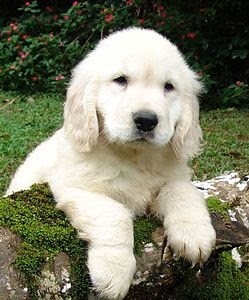
GOLDEN RETRIEVER

I now realise there are many more types of dogs than there are cats.  I could only find one "G" domestic cat but there are lots of "G" dogs but I have chosen this one as Emma was part of our family for 7 years and she was so beautiful.  I have photos of her that are not in my computer but she looked very much like this one:


The golden retriever is a large-sized breed of dog.  They were bred as gun dogs to retrieve shot waterfowl such as ducks and upland game birds during hunting and shooting parties, and were named retriever because of their ability to retrieve shot game undamaged.  They have an instrinctive love of water, and are easy to train to basic or advanced obedience standards.  They are a long-coated breed, with dense inner coat that provides them with adequate warmth in the outdoors and an outer coat that lies flat against their bodies and repels water.  Golden retrievers are well suited to residence in suburban or country environments.  Although they need substantal outdoor exercise, they should be housed in a fenced area because of their tendency to roam.  This dog sheds copiously, particularly in the change of seasons, and required fairly regular grooming.  (We used to have Emma groomed regularly so didn't have a problem with shedding in the house).


Its intelligence makes it a versatile breed and allows it to fill a variety of roles - common ones being as a guide dog for the blind, hearing dog for the deaf, hunting dog, detection dog, and a search and rescue participant.  The breed's friendly, gentle temperament means it is unsuited to being a professional guard dog, but its temperament has also made it the third most popular family dog breed (by registration) in the United States, the fifth most popular in Australia, and the eighth most popular in the United Kingdom.  They are rarely choosy eaters but require ample exercise (of two or more hours a day).  The are fond of play and Augie, a golden retriever from Texas, holds the world record for the most tennis balls held in the mouth by a dog.


The golden retriever is a large strongly-built breed with a dense weater-repellant coat.  As a dog with origins in pedigree breeding, and due to its widespread historical popularity, some regional variations have emerged in the breed so therefore there are three sub-types of golden retriever that reflect the typical variations in dimensions and coat.  However they are blonde, yellow gold in colour and all sub-types are susceptible to the same health problems.  They are very smart dogs who are loyal and friendly to their caregivers.


There are apparently British, American and Canadian golden retrievers but I am not going into all the ins and outs of the differences between them.  Suffice to say they are the most beautiful, well behaved and gentle dog to have as part of any family.


A friend of ours has had three secondhand golden retrievers all of whom have been named Jim.  Gerard visited us recently and brought Jim for a visit.  Jim and I became instant friends and he lay down by my feet and stayed there for such a long time and even now tears come to my eyes when I remember how beautiful it was to have such a lovely animal accept me at face value.  Jim is very much like the picture above.  So gentle and loving.

Our Emma came to us secondhand.   We had said goodbye some time before to our wonderful bull terrier "Princess" and it was time to have another dog in the house.  We saw an ad for a retriever and we called and were asked to come and meet this dog.  She belonged to a Scots lady who had just gone through a divorce and was returning to Scotland.  She needed a good home for Emma and we seemed to fit the bill.  While we were there having a cuppa a gentleman came to the door who was also looking for a dog and had seen the ad and telephoned.  When the owner opened the door Emma followed her and the man immediately said "That dog is too fat!"  Very rude of him I thought although Emma was indeed overweight as she apparently shared morning and afternoon teatime with her owner.  The man at the door then said "I'll soon get her weight off as we are vegetarians so she will be on a vegetarian diet".  The owner said she was so happy to tell him that she had already found a home for Emma and politely said goodbye to him.  She said she was so glad we had arrived first on the scene and so we took Emma home with us.

Although she seemed quite happy with us and responded to us very well we knew she was missing her previous mistress and if she heard a car door close she would immediately prick up her ears and we knew who she hoped it would be.  It often made us quite sad and we tried to make up to her for being abandoned by the lady she obviously loved so much.  She finally accepted us as her family and I am sure she became contented to be part of our household as much as we loved having her here.

Emma was a truly beautiful dog and loved to travel in the car. If on her own with Phil she would sit upright on the front seat (they were bench seats in his Valiant) and one day as I was driving home from work I saw Phil turn out of a side street a way in front of me.  When I caught up with him I was wondering who the lady with the beautiful hair was that he had in his car.  Of course it was Emma and we have often laughed about it over the years.  She really did look like a woman with a really wonderful hairdo and Phil didn't have a lady friend that I knew nothing about after all.

Emma lived with us for seven years until finally her kidneys gave out on her and we couldn't let her sleep in the house at night.  We had a huge cardboard box in the big garage where she slept quite comfortably but we knew it saddened her to be shut out of the house.  I have always been so very thankful to Phil for taking Emma to the vet when I was away on a camping holiday with a girlfriend.  He asked the vet's advice and was told it would be kinder to put her to sleep.  Although I was not there to say goodbye and of course missed the dear animal when I arrived back home I did appreciate it that Phil had borne the sadness of having to make that final decision, but then that's Phil.

Apologies for such a long post but memories of Emma came flooding back and I just had to write about how fortunate we were to have her spend some years with us.

Saturday, January 11, 2014

GERMAN REX

I had trouble finding cats beginning with G and this is the only one so here we go:

As the name suggests this breed of cat originated in Germany. It bears a striking resemblance to the famed British Cornish Rex, however the German Rex is not as popular as the Cornish Rex.


It is a medium-sized cat with long, slender legs and a round face.  Although muscular, it is heavier than the Cornish Rex.  The German Rex is also blessed with well-developed cheeks, large ears, and affectionate, alert eyes.  Its whiskers have a slight curl and its nose exhibits a small break.


The most remarkable feature of the German Rex, however, is its short, silk coat with extremely short awn hairs.  Unlike the Cornish Rex, the awn hairs are thicker than the hair in the undercoat which makes the coat look woolier.


 This a friendly, lively cat that will brighten up your day.  It gets on well with everyone, including children.  It is active and playful and can be taught to play games such as 'fetch'.  The German Rex is so intelligent it can be taught to perform acrobatic tricks on cue.  Though active, this breed has tremendous patience and is extremely loyal  When not playing with its owner, it enjoys lying down and being petted.

 This cat does not require much grooming.  In addition to regularly examining its ears and eyes for infections, it requires only a weekly brushing with a bristle or fine comb to smooth its hair.  Because it lacks sufficient hair to absorb oil secretions, it gets greasy easily and needs to be bathed frequently.  It should be wrapped in a towel immediately after bathing to make it easier to dry its hair.


The history of this cat can be traced to Germany in the mid-1940s (this is open to argument) but it was not taken seriously by most breeders until 1951, following the discovery of the Cornish Rex Cat in 1950.  Until 1979 the Cat Fancier's Association only recognised cats which resulted from a union between the Cornish and German Rex cats.  As they resembled each other, it was natural that one breed would overshadow the other.  The Cornish Rex continued to capture the public interest, while the German Rex participated in shows in its native land as late as the 1908s, fewer German Rex cats exist today.


Friday, January 10, 2014

FIERY SKIMMER DRAGONFLY

Class: Insecta.  Order: Odonata.  Family: Libellulidae.  Genus Orthetrum.  Species: villosovittatum.

The Fiery Skimmer Dragonfly is a brightly coloured dragonfly.  The male has a dark thorax and a bright red abdomen


 and the female has a brownish orange thorax and abdomen.  The abdomen is narrower near the front.


The two pairs of wings are about the same size with a wingspan of about 7cms.  The wings are transparent with a fine lattice pattern of veins; there is a small black patch on the leading edge of each wing near the wing tip.  Its size is 45mm and it is found around creeks, swamps and boggy ground. The adult dragonflies feed on flying insects. The female lays her eggs in the water dipping her abdomen in the water to lay the eggs.


These dragonflies are found in Queensland, New South Wales, Victoria, the Northern Territory and parts of Western Australia.  They are also found in Papua New Guinea.

Thank you to 'ozanimals' for this information and the picture.

Thursday, January 9, 2014

THOUGHTS ON THURSDAY

It is quite late at night (10.55pm to be exact) and I am thinking what was 'right' in my life today.  It has been a quiet and yet reasonably busy day and I can feel the weather is warming up.  Lots of laundry done thanks to my dear Phil who hangs it out for me and then brings it in for me to hang or fold and put away.

For that reason alone I have to say again that the 'right' thing in my life today and always is my husband.  He says he would be lost without me which I know is not really true, but I would certainly be lost without him here to help in so many ways.

P.S.  It has been forecast we in Perth will have a maximum temperature of 44ºC (111.2ºF) on Saturday and 39ºC (102.2ºF) on Sunday.  I knew when we had a much cooler than usual Christmas and New Year our weatherman would make up for it and he certainly is doing just that this coming weekend.  Thank goodness for air conditioning...whatever did we do without it in the past?

Tuesday, January 7, 2014

TELLING IT ON TUESDAY (OR MOST OF IT ANYWAY)

Having just celebrated my 82nd birthday a few days ago I began thinking back over of all those years and of significant happenings that had affected me during that time.  Just for fun (and to keep a record for my family who sometimes do view my blog) I thought I'd do a rundown of the years that brought changes in my life.  I hope others too may travel back in time with me and share what has been a reasonably uneventful life but a satisfactory one from my point of view with the odd ups and downs along the journey.

1932  A baby girl was born at Hillcrest Hospital in North Fremantle to a 21 year old single mother whose boyfriend refused to accept any responsibility for the baby.  In fact he married another woman before the baby was born.  His mother apparently had a hand in this although I've no idea why.  That baby was me and I think my birth mother would have liked to keep me as she did apply for maintenance but none was forthcoming. She had been told by her father (my grandfather) to "have the baby, forget it happened and get on with your life."  Finally she signed an agreement to have me adopted and she did fortunately name the man who was my father.  Because of that information I have found many details about not only my maternal family but also my paternal one as well.

1933  I was officially adopted and have a second birth certificate showing my new name.  In fact when I check the BDM website here in Perth I find I have been born twice!  Once in 1932 when I was Peggy Anderson and again in 1933 when I became Peggy Ruston.  I was so fortunate that the English couple that adopted me were well educated and respectable people.  Although my birth parents were both 21 at the time of my birth my adoptive folks were much older......mum would have been 34 and dad 46 at the time of my adoption.   They had a farm down south near Albany and I lived there very happily with them.  I don't have many recollections about farm life although I vaguely remember the layout out of the farm, the big pine trees and once helping mum and dad put out a bushfire that threatened our property.  I think much of what I remember about that period of my life was told to me by my mum and dad.   This is the only photo I have of the farm called "The Pines" (I think you can work out where the name came from):

These are my adoptive parents probably taken prior to my arrival on the scene.  There is no date on the back of the photo.  As you can tell it is quite an old black and white photo, possible from ca 1930:


With my new mum on the farm at Narrikup.  I was told that at birth I weighed about 10 lb.  Looking at this photo I can quite believe that is true:


1937  My mum had had major surgery and was very ill afterwards with thrombosis and other complications and I fear suffered some type of breakdown.  The doctor said if she didn't leave the farm he wouldn't guarantee she would live much longer.  After 17 years of farming the decision was made to go to live in Perth.  With all the medical costs etc., my folks had little left so they virtually walked off the farm with our clothes and a few pounds in their pockets.  (Note:  They had emigrated from England, arriving in Albany in 1920.  With them was dad's son Len, child of his first wife who had died when very young).  Dad's son at this time was a driver for Yellow Cabs in Perth and he received permission to drive to Narrikup (a trip of 485 km one way) and bring us up to the city.  In those days cab drivers wore a suit with leggings and a cap and looked very smart indeed.

1937  I had had correspondence lessons on the farm and although I was still only 5 years old mum wanted me to attend school.  They enrolled me at a state school near where we were living (in a boarding house where we had a room and shared facilities) but it didn't work out as I was being taught 'stuff' I already knew and although I don't remember this apparently it did my head in and I became ill.  That sounds so dramatic but a doctor we saw realised that was the problem.  This was told to me by mum in later years as I really don't recall any of it.

1937  Not far from where we lived there was a Catholic college and my folks were told it was an excellent school.  Mum had been bought up as a Baptist and dad had been C/E but to this school I went and I loved it.  As I had started when I was 5 it worked out that through all my years at Mercedes College I was always the youngest in my class.  I have no idea how mum and dad afforded to send me to this school as dad hadn't yet established himself in full-time employment but somehow they managed it.  I fear they went without for some time before dad became a very successful Rawleigh's dealer and things really began to look up.  I do know I loved the 4 nuns who had taught me through my 6 years at the convent.

1938 We moved to another big house where we had two rooms and shared conveniences and it was directly opposite my school so never any problem with being late for school.  During the next 14 years we moved several times until eventually mum and dad build themselves a house in 1952.
This is a picture of mum (she was probably about 42 then)  and me (aged 7) in the back garden of the house at 196 Goderich Street.  Incidentally, mum didn't curl my hair but just brushed it and wound it around her finger to make ringlets.


 With friends and school friends at my 7th birthday party in 1939:


1939  Sees the beginning of hostilities resulting in World War 2.  My half-brother Len had enlisted in the Royal Australian Air Force in 1938 and I must admit I thought he looked so handsome in his uniform.  I was 7 at that time and, he being nearly 21 years older than me, in many ways he was more like an uncle but I remember he was always wonderful to me.  I was always so proud of my big brother.  It was during 1939 that Len met up with a young woman who, with her mother and 3 sisters, had come to live in Perth after the father of the family had died.  They had been farming at Brookton for many years.  Len and Jean became engaged and planned to marry in 1940.  This photo was taken at a family day at Pearce Aerodrome.  I don't know why Len is pulling a face like that.  Next to him is his future wife Jean and then my mum and dad.  My, how folk used to dress up in those days.  Len here was in the RAAF summer uniform and not his lovely dark blue one.


Well that was the 1930s.   I am not sure that any of this is very interesting to anyone other than my family.  Should I continue?  I would appreciate it if you would say yay or nay to that question, please.
Several of you kindly said you were interested about my life story.  Now you've read the first episode in this saga of mine, is it worth continuing?  I did warn you it was and is a very ordinary life. Should I continue including any photos I happen to find?  Your comments will guide me for future episodes.
Thank you for your interest and your patience.