Ultricularia menziesii is a very common plant from Israelite Bay east of Esperance to the north of Perth in Western Australia, on or near coastal moss covered granite outcrops, or on the edge of drainage channels carrying flood water from one swamp to another. They don't actually grow in water, but in waterlogged soils, particularly those that are slow moving or draining, which probably carry living organisms their way.
The beaming red flowers are between 2-3 cm (1") in length and despite their fragile appearance, will bloom over several weeks providing the moisture does not dry up. When conditions do become too dry they will die back to the corm, where it will remain dormant until the following growing season. The flowers themselves do not trap insects, but are functional and serve only to attract suitable pollinators. The flowers are produced from June to September.
There were a couple of other "U" plants but this was the more spectacular and well worth sharing.
Wednesday, November 13, 2013
Tuesday, November 12, 2013
HAS POLITICAL CORRECTNESS GONE COMPLETELY BONKERS?
In our daily newspaper (The West Australian) yesterday there was an article concerning orang-utans which in itself was very interesting and I know these poor creatures are in danger of losing their habitat due to clearing etc. When you consider how closely related they are to we humans we should all be particularly concerned about their future.
That was not what my gripe is about. Over the years we have always referred to the orang-utan as "The Old Man of the Forest". The article by this person (yes, she was female) called the orang-utan "The Person of the Forest"! Now, I ask you have you ever known political correctness to be so ridiculously overdone as it was here, or am I just being pedantic?
T is for Thelymitra variegata, speciosa, pulcherrima
This orchid, which is endemic to Western Australia, grows amongst low scrub in sandy soils where it flowers from June - September. It is known as "Queen of Sheba" for obvious reasons and consists of three regional subspecies. They are distinguished mainly by flower colour and distribution. The northern variety is found north of Perth on the coastal plain. The eastern variety is found from the Stirling Ranges east to Esperance and the southern variety is found from Bunbury to Albany along the south coast. There are many variations between the three subspecies:
The Southern Queen of Sheba (Thelymitra variegata):
The Northern species (Thelymitra pulcherrima):
and the Eastern species (Thelymitra speciosa):
and this is a truly beautiful photograph I found which I had to share. It is quite magnificent and shows all the lovely colours in the one flower. I am not sure which of the 3 varieties it is, but possibly the Eastern variety:
This shows the characteristic spiral leaf of the plant:
This flower was also featured on one of our $1 stamps:
The Southern Queen of Sheba (Thelymitra variegata):
The Northern species (Thelymitra pulcherrima):
and the Eastern species (Thelymitra speciosa):
and this is a truly beautiful photograph I found which I had to share. It is quite magnificent and shows all the lovely colours in the one flower. I am not sure which of the 3 varieties it is, but possibly the Eastern variety:
This shows the characteristic spiral leaf of the plant:
This flower was also featured on one of our $1 stamps:
Just for the sheer fun of it here are more Thelymitra species all of which are found in Western Australia. There are other species found in other parts of Australia as well.
There are many flowers beginning with the letter 'T' and, as with 'P', I may do some more posts after "Z"
Monday, November 11, 2013
S is for SO MANY TO CHOOSE FROMll
Scaevola striata commonly know as the Veined Fan Flower is a native of Western Australia and found in the botanically rich southwest corner of the State. It is a dwarf, spreading perennial herb that may sometimes sucker. The leaves may be up to 6 cms long and 2 cms wide, oblong to ovate, deep green, with toothed margins and a pointed apex. The flowers are 4 cms across, bluish-purple or pink with white or yellow throats. Blooms are held in sprays that may reach 30 cms (1 ft) in length. The flowers are always conspicuous and can be very abundant. This plant flowers through spring and summer with sporadic flowering at other times. It is a very popular garden plant. (There are about 40 varieties of Scaevola in Western Australia).
There are 3 species of Sowerbaea found in Western Australia (out of a total of 5 species) and one of these species is Sowerbaea laxiflora Lindl. It is a tufted perennial which grows down the west coast, and some inland areas, mainly from Geraldton south to Albany. It is known as Purple Tassels and is a tufted perennial herb 0.15-0.45 m high. It has purple flowers August to November.
Stylidium (also known as trigger plants) is a genus of dicotyledonous plants that belong to the family Stylidiaceae. Pollination is achieved through the use of the sensitive 'trigger' which comprises the male and female reproductive organs fused into a floral column that snaps forward quickly in response to touch, harmlessly covering the insect in pollen. Most of the approximately 300 species are found in Australia, making it the fifth largest genus in this country. Trigger plants are considered to be protocarnivorous or carnivorous because of the glandular trichomes that cover the scape and the flower can trap, kill and digest small insects with protease enzymes produced by the plant. If you wait a moment or two hopefully you will see the trigger working on this little yellow flower:
In Western Australia alone, there are now more than 150 species, at least 50 of which are in the area immediately around Perth. One of the larger species is Stylidium schoenoides or "Cow Kick" so named for the powerful 'kick' when triggered. The flowers of this species are only 5cm (2"). so most of the Stylidium flowers are very small.
I can remember, as a child. being really intrigued by these plants and loved to gently touch the flower to make the trigger work. It is many years now since I have seen one.
Senna cardiosperma is an inland species and common in the Kalgoorlie region of Western Australia. It also occurs around Esperance in the mallee, arcing 100km (over 60 miles) NW to the NE and becoming more common further north. It germinates readily in a variety of well-drained soils after bushfire or soil disturbance and can grow to around 2 metres (6') high, although most plants are usually shorter and quite bushy.
The flowers tend to be distinctly yellow when growing in sandy loam but develop an orange tinge when growing over gravel. It is a prolific producer of flowers and flowering times are usually between July and November.
There are 3 species of Sowerbaea found in Western Australia (out of a total of 5 species) and one of these species is Sowerbaea laxiflora Lindl. It is a tufted perennial which grows down the west coast, and some inland areas, mainly from Geraldton south to Albany. It is known as Purple Tassels and is a tufted perennial herb 0.15-0.45 m high. It has purple flowers August to November.
Stylidium (also known as trigger plants) is a genus of dicotyledonous plants that belong to the family Stylidiaceae. Pollination is achieved through the use of the sensitive 'trigger' which comprises the male and female reproductive organs fused into a floral column that snaps forward quickly in response to touch, harmlessly covering the insect in pollen. Most of the approximately 300 species are found in Australia, making it the fifth largest genus in this country. Trigger plants are considered to be protocarnivorous or carnivorous because of the glandular trichomes that cover the scape and the flower can trap, kill and digest small insects with protease enzymes produced by the plant. If you wait a moment or two hopefully you will see the trigger working on this little yellow flower:
In Western Australia alone, there are now more than 150 species, at least 50 of which are in the area immediately around Perth. One of the larger species is Stylidium schoenoides or "Cow Kick" so named for the powerful 'kick' when triggered. The flowers of this species are only 5cm (2"). so most of the Stylidium flowers are very small.
I can remember, as a child. being really intrigued by these plants and loved to gently touch the flower to make the trigger work. It is many years now since I have seen one.
Senna cardiosperma is an inland species and common in the Kalgoorlie region of Western Australia. It also occurs around Esperance in the mallee, arcing 100km (over 60 miles) NW to the NE and becoming more common further north. It germinates readily in a variety of well-drained soils after bushfire or soil disturbance and can grow to around 2 metres (6') high, although most plants are usually shorter and quite bushy.
The flowers tend to be distinctly yellow when growing in sandy loam but develop an orange tinge when growing over gravel. It is a prolific producer of flowers and flowering times are usually between July and November.
You know of course why I chose the last one....yes, it's yellow!!
Sunday, November 10, 2013
R is for a RANGE OF VERY DIFFERENT PLANTS
I have to admit that Q beat me. Maybe I should have cheated and kept the Quualep Bell (that beautiful Pemelea) for my Q but it's gone now so on to the R's of which I found rather a varied lot.
Rhodanthe condensata flowers look like the product of an origami class being white and looking so much like folded paper flowers. It is one of the so-called everlasting flowers which can grow in their thousands if the conditions are right in spring. It has a restricted range and is mostly found north of Geraldton, Western Australia and around Kalbarri close to the coast. although there are one or two inland sites dotted about.
Rhodanthe chlorocephala ssp rosea or pink everlasting can be white, pink or yellow and is found inland from Kalbarri towards the wheatbelt and extending into the desert beyond. It is a favourite with gardeners as it can be more easily grown than many native species and will even seed itself from one year to the next.
I remember when travelling north to Carnarvon many years ago seeing acres of these beautiful everlastings on the roadside. They are often grown in suburban Perth on road verges and the like and always look so lovely.
Ricinocarpos megalocarpus (Wedding Bush). The large showy petals of this plant are amongst the most ornamental of the extremely varied Euphorbiceae family.
It is a very hardy species. thriving in strong salt laden winds and deep white non-calcareous sand. It occurs from Esperance to Cape Arid 110km (70 miles) to the east where it can be very common, growing to 4 metres (12') in height and usually less than a kilometre/mile from the beach. This plant is growing on the beach at Alexander Bay:
The areas where this species grows is frequently subject to very stormy weather and strong sandblasting winds, yet it is very much at home, often taking the full force of whatever nature delivers.
It produces male and female flowers, usually on the same bush, but at times with only a single gender. The plants are careful not to self-pollinate by producing female flowers first and once pollinated (by other earlier flowering plants), they produce the male flowers that far outnumber the females. Flowers can be found at any time of the year except during extended dry periods, as new blooms are quickly produced after soaking rain, and flowers and the warty fruits can be found in all stages of development.
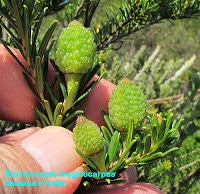
Immature and mature fruits:
It is mostly between October and late December when the flowers completely obscure the foliage:
Rinzia dimorphandra is found mostly to the east of Esperance to the Cape Arid region. It needs regular bushfires to reduce competing vegetation, otherwise it is quickly smothered, so they are usually only around for a few years before disappearing to await another fire.
It usually grows to around 30cm (1') in height with a sparse twiggy structure and small leaves that are appressed to the stem making them virtually invisible to spot when not in flower. When it does bloom, the flowers (to 1cm or 3/8") are a delightful pale, to deep pink, that demand your attention. Normal flowering period is in October although they have been seen flowering at other times of the year.
Most Western Australians will recognise this one, it is a weed: Romulea rosea (Guidford grass) is an alien from the South African Cape area and is a well established weed in Western Australia. Romulea rosea can reproduce by seed or vegetatively through cormlets and as the leaves normally lie very flat to the ground it isn't easily disturbed by mowers or suchlike. This is most probably var australis as it has a yellow centre and a white band. It is also known as onion grass and Rosy Sandcrocus. (I have only ever known it to be called Guildford grass and it has been around forever in my memory. Its seed capsules we used to call 'puddings' and actually, if I remember correctly, as children we used to eat them but then kids do funny things.) Here it is shown growing in rough ground at the edge of a well used path which shows how well it has adapted to the very similar Western Australian climate:
My thanks once again to "Esperance Wildflowers" and other sites for the information and photographs shown here. I had to add the Guildford grass as it has always been so much part of my life since I was a child. We have it growing on our verge but fortunately there is none in our garden.
Rhodanthe condensata flowers look like the product of an origami class being white and looking so much like folded paper flowers. It is one of the so-called everlasting flowers which can grow in their thousands if the conditions are right in spring. It has a restricted range and is mostly found north of Geraldton, Western Australia and around Kalbarri close to the coast. although there are one or two inland sites dotted about.
Rhodanthe chlorocephala ssp rosea or pink everlasting can be white, pink or yellow and is found inland from Kalbarri towards the wheatbelt and extending into the desert beyond. It is a favourite with gardeners as it can be more easily grown than many native species and will even seed itself from one year to the next.
I remember when travelling north to Carnarvon many years ago seeing acres of these beautiful everlastings on the roadside. They are often grown in suburban Perth on road verges and the like and always look so lovely.
Ricinocarpos megalocarpus (Wedding Bush). The large showy petals of this plant are amongst the most ornamental of the extremely varied Euphorbiceae family.
It is a very hardy species. thriving in strong salt laden winds and deep white non-calcareous sand. It occurs from Esperance to Cape Arid 110km (70 miles) to the east where it can be very common, growing to 4 metres (12') in height and usually less than a kilometre/mile from the beach. This plant is growing on the beach at Alexander Bay:
The areas where this species grows is frequently subject to very stormy weather and strong sandblasting winds, yet it is very much at home, often taking the full force of whatever nature delivers.
It produces male and female flowers, usually on the same bush, but at times with only a single gender. The plants are careful not to self-pollinate by producing female flowers first and once pollinated (by other earlier flowering plants), they produce the male flowers that far outnumber the females. Flowers can be found at any time of the year except during extended dry periods, as new blooms are quickly produced after soaking rain, and flowers and the warty fruits can be found in all stages of development.
Immature and mature fruits:
It is mostly between October and late December when the flowers completely obscure the foliage:
Rinzia dimorphandra is found mostly to the east of Esperance to the Cape Arid region. It needs regular bushfires to reduce competing vegetation, otherwise it is quickly smothered, so they are usually only around for a few years before disappearing to await another fire.
It usually grows to around 30cm (1') in height with a sparse twiggy structure and small leaves that are appressed to the stem making them virtually invisible to spot when not in flower. When it does bloom, the flowers (to 1cm or 3/8") are a delightful pale, to deep pink, that demand your attention. Normal flowering period is in October although they have been seen flowering at other times of the year.
Most Western Australians will recognise this one, it is a weed: Romulea rosea (Guidford grass) is an alien from the South African Cape area and is a well established weed in Western Australia. Romulea rosea can reproduce by seed or vegetatively through cormlets and as the leaves normally lie very flat to the ground it isn't easily disturbed by mowers or suchlike. This is most probably var australis as it has a yellow centre and a white band. It is also known as onion grass and Rosy Sandcrocus. (I have only ever known it to be called Guildford grass and it has been around forever in my memory. Its seed capsules we used to call 'puddings' and actually, if I remember correctly, as children we used to eat them but then kids do funny things.) Here it is shown growing in rough ground at the edge of a well used path which shows how well it has adapted to the very similar Western Australian climate:
My thanks once again to "Esperance Wildflowers" and other sites for the information and photographs shown here. I had to add the Guildford grass as it has always been so much part of my life since I was a child. We have it growing on our verge but fortunately there is none in our garden.
Friday, November 8, 2013
P must stand for PRETTY PIMELEA
Pimelea (often seen spelled Pimelia which is in fact the name of a genus of beetle) is a genus of plants belonging to the family Thymelaeaceae. There are about 80 species in the genus, native to Australia and New Zealand. Many of the species are poisonous to cattle and horses.
Here in Western Australia we have some very beautiful Pimelea, including.
Pimelea rosea which is an erect shrub 0.3-1 m high with pink/red-purple flowers July to December. It grows on sand, sandy clay and gravel on coastal sands and dunes, limestone or granite rises.
Pimelea physodes (Qualep bell) grows on the sandplains and hillsides in the south of Western Australia. It is arguable the most spectacular member of the genus due to its large pendant flower heads. It is prized as a cut flower. It grows to about 1 metre high with oval shaped leaves and small flowers whihc occur in clusters at the ends of the branches. and are enclosed in leafy bracts. These may be yellow. green, red or purple in colour. Flowers appear in winter and spring.
Pimelea calcicola is yet another species occurring in Western Australia. Its pink flowers are produced in September-November:
Pimelea aeruginosa is mostly an inland species, occurring from west of Kalgoorlie to the Geraldton region, then SE to Esperance. The individual hairless flowers are slender tubular and individually are not particularly ornamental, but are clustered within 2-3cm (1") diameter yellow bracts, which go on to develop an orange bush as the internal flowers progress to seed. These plants flower from May to October.
Pimelea brachyphylla is a common and widespread species around Esperance. It can grow to a metre (3') high and flowers can be bright pink in bud but will open to a sparkling white to form attractive multi-flowered heads. They flower anytime from June to October and are very attractive to butterflies:
Pimelea nivea is not native to Western Australia (it grows in Tasmania from sea level to about 1200m) but I thought the photos of the bud and flower were so cute I had to include them.
I could include dozens more of these spectacular plants but I have to draw the line somewhere. Hopefully I've been able to show the diversity of these plants which do grow quite well in home gardens although I am not sure which species are suited to which climates etc.
Strangely enough there are many other plants also beginning with the letter P. Q may prove to be impossible and I may do the R and T and perhaps go back and do more of the P flowers. As far as I know there's not many beginning with R but I am sure to find one or two and I have a very special T stored up, ready and waiting. May be difficulty with UVXYZ; haven't even glanced at them yet so could be fortunate in finding any at all.
Here in Western Australia we have some very beautiful Pimelea, including.
Pimelea rosea which is an erect shrub 0.3-1 m high with pink/red-purple flowers July to December. It grows on sand, sandy clay and gravel on coastal sands and dunes, limestone or granite rises.
Pimelea physodes (Qualep bell) grows on the sandplains and hillsides in the south of Western Australia. It is arguable the most spectacular member of the genus due to its large pendant flower heads. It is prized as a cut flower. It grows to about 1 metre high with oval shaped leaves and small flowers whihc occur in clusters at the ends of the branches. and are enclosed in leafy bracts. These may be yellow. green, red or purple in colour. Flowers appear in winter and spring.
Pimelea calcicola is yet another species occurring in Western Australia. Its pink flowers are produced in September-November:
Pimelea aeruginosa is mostly an inland species, occurring from west of Kalgoorlie to the Geraldton region, then SE to Esperance. The individual hairless flowers are slender tubular and individually are not particularly ornamental, but are clustered within 2-3cm (1") diameter yellow bracts, which go on to develop an orange bush as the internal flowers progress to seed. These plants flower from May to October.
I could include dozens more of these spectacular plants but I have to draw the line somewhere. Hopefully I've been able to show the diversity of these plants which do grow quite well in home gardens although I am not sure which species are suited to which climates etc.
Strangely enough there are many other plants also beginning with the letter P. Q may prove to be impossible and I may do the R and T and perhaps go back and do more of the P flowers. As far as I know there's not many beginning with R but I am sure to find one or two and I have a very special T stored up, ready and waiting. May be difficulty with UVXYZ; haven't even glanced at them yet so could be fortunate in finding any at all.
Subscribe to:
Posts (Atom)